When I start each class I pass out a "getting to know you," worksheet. One of the things I ask is what television shows they like. That way I can use their TV shows in class. This class likes the Big Bang Theory, and I was lucky enough to find this great clip online using 2nd Conditionals.
I used this video with my students today to practice for the TOEFL, and (to make it more interactive) we practiced making conditionals WITHOUT if by using Subject verb inversions.
It worked really well. The students worked in teams, and at the end the team with the most right answers won.
I stopped at 2:48 as after that they get a bit too long and slightly more complicated.
For example:
Ifthatwere a movie I wouldgoseeit.
turns into
Werethat a movieI wouldgoseeit.
and
If I weretoask
Leslie Winkleoutitwouldjust be fordinner.
turns into
Were I toask Leslie Winkleoutitwouldjust be fordinner.
June 4th my students had their first Partial Exam. Since we started class with the test we ended it with a pretty easy suffix and prefix activity. We went over some suffixes(ship, ful, etc.) and prefixes (hetero, arch, etc.) and then I gave them a bunch of root words: friend, bishop, chamber, sex, etc. I paused before writing sex on the board, but I wanted something that would go easily with hetero.
The assignment was to come up with as many words as they could combining the root words, prefixes and suffixes.
I told them that we would go over the answers at the end, and if they weren't 100% certain it was a word just guess! It was mainly important that they came up with new meanings.
As they are making their lists I get a lot of, "Teacher is ________ a word" to which I responded, "We'll go over them at the end. Just guess!" Class continued, but I kept getting the same question. In the end I started abbreviating my answer to, "maybe"
I get the question from a group of boys,
Students: "Teacher is _____ a word?"
Me: "Maybe"
Student A: "She said maybe. That means yes"
Really guys? Maybe means yes?
Me: "I am not sure what girls you have dated, but that's not how it works"
They were amused and finally stopped asking!
They continued working on the list and one of my sweetest most hardworking students asks, "Teacher... is sexship a word?"
It is on Urbandictionary, and I've seen it on twitter, but it has yet to become mainstreamed. I just quietly asked her "what type of relationships do you normally have?"
Just a quick notice that tomorrow there is a Webinar on differentiation. It was one of the areas of education I was most into during my Masters (other than Papiamentu) and I admit I have strayed away from it a bit this year.
The Webinar will take place Wednesday, June 6th 3:00PM-4:00PM EDT.
Per the ASCD website:
"Curriculum,
assessment, and instruction create a system of interdependent parts.
Bring the standards and curriculum to life by using differentiated
instruction methodologies to maximize the capacity of each learner. By
the end of this webinar, presented by Carol Ann Tomlinson and Sherida
Britt, participants will be able to
• explain why common core calls for attention to student differences.
• determine the ways differentiation supports the instructional shifts of the common core."
You can register here: https://www1.gotomeeting.com/register/855280081
I just got an e-mail from a friend the other day that she was using a body part game I introduced to her which the kids ALWAYS love, so I figured I'd share it.
It's one of those great games that doesn't actually require much set up. I have used it with older students, but I'll walk through the little kiddie one and you can change it as you wish.
In all fairness I snagged the concept from a scene in the movie Dave
The students at this point have normally learned, "Hello," "My name is" "What's your name" and "How are you today" along with some emotions. The next unit is normally body parts soo...here we are.
First, I tell them I want them to meet a friend of mine. What do we do when we meet a friend? Eventually some student says, "Say Hello" or "What's your name." As they are guessing, I draw my friend on the board (you can draw a whole body for other body parts, but my paint skills are lacking so I just did the face here):
My friend Joe
Teacher: "Do we know his name?"
Students: "Nooo"
Teacher: "How do we ask?"
Students"Hi, What's your name"
Teacher, "My name's Joe"
Students, "How are you today?"
Teacher. "I am not feeling well"
Teacher "Repeat after me: Oh No!"
Students "Oh No"
Teacher "Poor Joe"
Students "Poor Joe"
Teacher "He has no"
Students "He has no"
My friend missing something
***erase a body part****
Teacher: "What is Joe missing?"
Students: "Ears!"
Teacher: "Great, so all together:
Students and Teacher: "Oh no, poor Joe he has no ears!"
***Draw the ears back on and repeat erasing a different body part***
When your students get the hang of the chant (which they LOVE) see if you can get them involved!
Have them come up in from of the class and "become" Joe. They will practice introductions again, (Hi, what's your name? My name is Joe. How are you? etc.) Then the student should turn AWAY from the rest of the class. The class starts, "Oh no! Poor Joe, he has no..." and then the student turns around, only this time the student is covering something (eyes, ears, mouth, elbows...I've had students tuck their hands into jackets or arms into shirts) the students quickly pick out what is missing and finish the chant.
This is a quickly made example of the beat with the words. Students really don't care how well drawn Joe is!
This game can be altered to use powerpoint, prezi, posterboards, hand made cards, etc. I've seen it done very nicely with large cards here. It can be used with clothes (Oh no poor Joe, he has no scarf!). Though if you use clothes, be sure to bring in extras so you don't have students taking off their pants in class. You can make handouts with the pre-written chant, "Oh no! Poor Joe, he has no _______" and have students fill in the blanks and draw a picture. Really it is just a great springboard or wrap-up.
You can download the directions for class and a quick worksheet for your students for $1 just check my store on TPT if you aren't already signed up you can do that here)
Anyways, this game has helped me with lots of classes (and relentless random children at banks) so hopefully someone else can use it too.
Do you have a go-to game that is little to no prep for if you get called in to sub a class? Or you need to fill up an extra ten minutes at the end? The other one I love is flyswatter, but I think most teachers use that.
BONUS: I just made a new version for Winter. check out, "Oh No, Poor Snow"
That lovely bunch of smiley faces is my family. Four of the eight adults are or have been English Teachers. So usually when I hit a brick wall or need help on a topic I pull an E.T. and call home.
However, the internet has truely changed how I can react. There is help all over the place, though I still call my mother quite often. While most of my friends plan their upcoming weddings (real or imaginary) on pinterest I tend to find the some great teaching ideas and graphics on pinterest...and what an easy way to organize them!
For example I have a bunch of pictures/comics related to punctuation: http://pinterest.com/carisita/punctuation/ some of them I have found and some of them I have raided of other people's pinterest boards.
I also have board for each of the classes I teach so later I don't
need to remember what that article I used last year was, or where I
found that great comic that one time.
Anytime someone likes or Re-Pins one of my suggestions I get told. That is helpful since most people who like things that I like are probably collecting things that I can also use in my classes!
Do you use pinterest? Should I be raiding your board? Please let me know if there's anything about Pinterest you that I am missing!
I am not always lucky enough to have books with me
I don't have a bookshelf that travels with me from location to location, but I always try to give my students varied reading choices regardless of the empty shelves! I can have access to so many stories with the click of a mouse.
Magazines, blogs and newspapers are all an awesome source of reading materials, but sometimes it is nice to have something a bit more permanent. When you change age groups as much as I did it is nice to know that there are some free reading sources you can legally get (I can't very well discipline at students for plagiarizing if I don't keep to the same moral code)! Following is a quick non-comprehensive list of sites I have found helpful for reading materials.
If you teach the younger crowd check out WeGiveBooks. I would have KILLED to have known about this site when I was teaching pre-school and kindergarten (or even when I au-paired in the Netherlands). In addition to free e-books (many of them popular children's books not just similar characters doing similar things) when you finish reading a book you can click to donate a book! As a San Diego girl I LOVE that the San Diego Padres are behind this. How great is that?! They also have resources for teachers (everyone from pre-school to 12th grade!) So to summarize, you get free books, you get to help out people who also need free books, AND the Padres rock :)
Wily Writers is a place I have found some great short stories. My favorite part is that you can normally contact the authors to let them know that you are using their story. Sometimes they will answer questions from your students, other times you can set up a skype date. If nothing else you can have students e-mail them a thank you. For example I was lucky enough to find Jess Hartley who has written some great short stories we used in my class and was kind enough to chat with my students! More on that here. They also quite often have the audio version of the story.
Free-e-books well with a name like this there isn't much left to the imagination. With a bigger focus on newer e-books this site is a nice way to find some modern examples of English for students to read.They have "educational" books, general non fiction, humor, short stories, and young adult. With so many options there has to be something that works for you.
NEW(added 6/16)Smashwords is a site I was just introduced to and it is AWESOME. It has books for sale as well as freebies. They seem to add new books every day for a constant supply of good reads.
NEW (added 3/15/2013) Flip Builderis a cute java site that has people actually "turning" pages. Not everything is free but the collection for little ones is pretty cute!
Made for Teachers
ESLMonkeys
is a great site as well! A lot of the books are resource books, and
there are a bunch of dead links but there's also some great interactive
reading sites linked (Ghost Forest
has a trailer to entice you into reading more.) ESLMonkeys also links
to a short story by Robert Norris who in addition to selling his story
as an e-book, a podcast and in print offers it to teachers and students
for free online! The Many Roads to Japan: A Search for Identity is about John Banks and how he ends up in Japan. Basically the site has tons of fun free stories that English Language learners are sure to find interesting.
ELCivics
isn't my favorite but for newer teachers who aren't comfortable enough
working with authentic materials it offers 3 easy to use books with
quick short stories and comprehension questions. It looks like it is
designed for lower intermediate adults, but it is definitely worth a
look.
Teachers Pay Teachers has 2,972 Guided Reading worksheets right now. 349 of which are free! They have every age level up to worksheets for adults. Similar to BusyTeacher these often contain built in activities as well! If you don't already have an account you can go straight to their sign-up page here
BusyTeacher
Many teachers share not only worksheets but graded readers, short
stories, magazine articles, etc. Often they even include activities.
ManyBooks is very similar with many of the same books. They do have a nicely organized section on fairy tales of the world which would be easy to turn into an international unit. They also have recommendations which I think are pretty fun! You can view what other readers recommend here you can read reviews of stories available. You can also make a bookshelf of your favorites and view other people's bookshelves to get ideas.
BartelbyI used to use Bartelby all the time in high school to find quotes to use in my essays. Now they have upped their game and offer books much like Gutenberg and ManyBooks. They tend to go a bit more poetic but they also have books.
Most of these you can access with any normal computer, however I know that reading tablets are all the rage now. My friend has a kindle and swears by it so you may want to consider the investment.
Where do you go to find reading? Do you use more magazines and articles or do you prefer books?
Oh TOEFL TOEFL TOEFL. Well, this year I have taught my first TOEFL class ever. It went... well. The class was a TOEFL class and a writing class. Not as many students passed as we would have liked, so when I give the class again in the Summer it will just a be a TOEFL course.
I am in the process of re-writing the course (with supplementary materials to make a 3 hour daily TOEFL course slightly less boring)
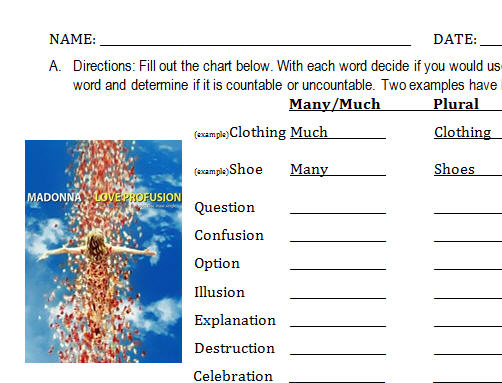
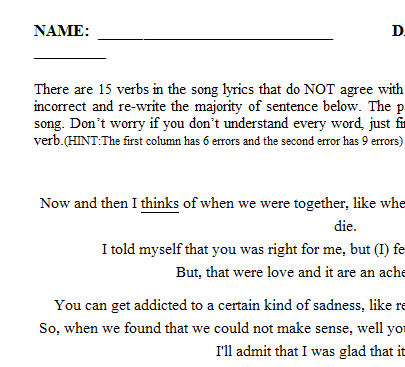
I am trying to add some songs whenever possible Madonna's Love Profusion for when we review uncountable nouns (and more importantly the quantifiers that go with them) and mainly because I LOVE the music video "5 people 1 guitar" I used Somebody that I used to know for Subject / Verb agreement.
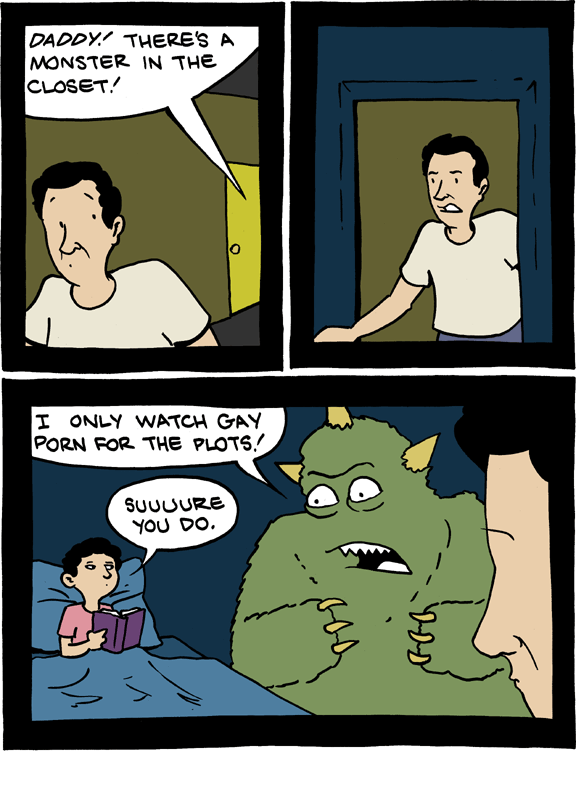
Idioms can be confusing. Is a Monster in the closet literally... or figuratively? And what does it mean figuratievly anyways?
My students are actually pretty good at these (YAY for one thing I don't need to review for this Summer's TOEFL course) but what I really like about this site is the ability to find idioms in other languages.
This way you can give students an example of something that is not literal in their language (compared to a direct translation of the english idiom).
Yes yes I know I know avoid translations when possible, but this is something I have found that really helps students understand the concept behind idioms rather than just memorizing words which don't seem to make sense.
The site: http://www.idiomizer.com/idioms/
Let me know how you teach idioms or what you think of the site!
My boss actually came into my office yesterday to tell me that my evaluations this time had improved. I wouldn't be able to view the evaluations until the 18th, but he just wanted to let me know.
That took some pressure off me and I was not dreading reading my evaluations.
My 7am/3pm classes were a little mixed. They felt that since they needed a good TOEFL grade to pass they should have had more TOEFL practice. We did do TOEFL practice, buta lot of it was "hidden" in other activities. We also did lots of reading, but it wasn't multiple choice TOEFL style.
Anyways, we decided the students are right and we are changing the class to be more TOEFL based. Most the reviews were pretty generic:
"Fun class, i like to go..she makes interesting the class."
"Sus clases son muy dinamicas, lo que convierte a la materia en una clase interesante y motivadora."
"muy buena maestra, buenas clases,comprensible y buena para enseñar."
"Excellent! Teacher maybe i really don't love your explanations buy i
love the way we practiced all, you put a lot of time to plained our
class, i think you were my best english teacher ever! i've learned
more english in this class than in all my life really! but all depends
about my toefl score, that is the bad thing :c jajajaja but i really
will miss you"
"I love this class. Just one thing i do not like; take the class in the afternoon is so annoying. But the class is ok."
Those made me happy since I do try to make class interesting.
My 8:30 class had a lot of duplicates. A few chatty students, but overall I think they did well:
"Nice teacher just a little weird"
"Excelente teacher, me gustan sus clases, siento que pasan bien rápido, me divierto y aprendo." "A very good teacher. The best teacher in the ITESM."
"Excelente profesora, aunque puede llegar a aplicar metodos poco
ortodoxos alguna vez, es capaz de llegar a nosotros los jovenes para
poder aprender de una manera mas esencial y no solo por 'machetear'."
and finally
"Hello Carissa, you´re a great teacher, although you scream often,
it´s okay, because your class is better that way. You´re class is very
fun, we always do different things and try to support us in every way.
Thanks for the consult, we´ll meet again at you´re office ;)"
So I am improving...I suppose that's good ... though now I am a bit nervous about continuing to improve, I suppose I can just keep trying the hardest that I can.
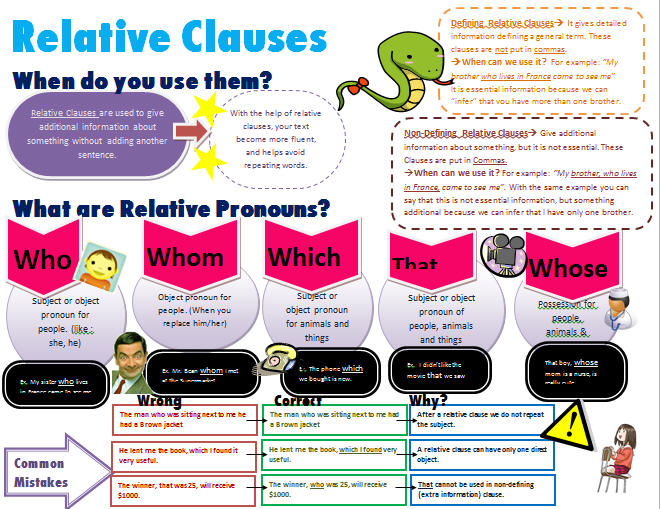
My final assignment for my Lengua Extranjera class was to make a cheat sheet for something we had covered. One student did a fantastic job! She made a relative clause sheet that reviewed the basics. I uploaded it to busyteacher (I love this site!).
Check it out, or leave a comment and I'll e-mail it to you if you have problems with the busyteacher site.
So as discussed in the prior post the LARC has had webinars about assessment in the past. There was also a TOEFL Spain presentation on the different ways to assess homework.
Well this time I had the change to listen to Susan Weigle discuss assessing writing. You can read more about her and the webinar here: http://larc.sdsu.edu/webinar-sara-weigle/ She is a published and respected teacher, but this was her first webinar, and it showed. I am not honestly sure I would recommend watching the recording to anyone, but you can find it linked above. AGAIN Sara is very qualified, but the webinar appeared to be a bit too much. She was often overwhelmed and honestly I struggled to get through the presentation. Participants as well seemed to be clueing out and asking questions that she had already answered. No worries, everyone struggles their first time and I am sure she will improve with each webinar.
So, she started by going into the basics of writing, authentic writing tasks versus the tasks where we use writing to check grammar or vocab comprehension. For me this was a reminder that whenever possible we should try to keep our assignments as authentic as possible (kinda hard given I am currently teaching academic writing, but still).
Then she discussed Hamp-Lyons definition of a writing test:
Test takers must write one piece of continuous text
Test takers are given a prompt or instructions on what to write
Writing is evaluated by at least one trained grader
Graders judge using a rubric or set scale
Judgments are given as numbers or grades
How can writing be assessed without being tested? Webinar participants suggested logs, journals, timed writings, chat forums, portfolios, essays, fb group discussions, etc I would actually argue that many of these fall in the definition of the writing test per above, but I suppose it depends on if a rubric is used or not (I use them with every assignment I give for consistency). Sara goes to specifically define a test as an in class timed writing, compared to take home essays.
Then she discusses the components of a test, the task (what they should write) and the scale (how we grade it).
She gave us the topics (http://www2.gsu.edu/~wwwrtp/topics.htm) that University students have to write on to prove they are university level writers. Most of the webinar agreed that for high school or EFL learners the topics were fine but they were a bit too broad for an academic timed writing.
To avoid having a task that doesn’t meet up with the students’ (or teacher’s) needs it is important to remember the principles for task design.
Clarity Students need to understand what they are doing (a colleague of mine discussed an exam the other day where she asked students to write on one of the topics in the box below. She also reminded them to use good grammar and watch their spelling. Several students wrote on why using spelling and grammar is appropriate. This is the result of unclear topics(or students who don’t pay attention) )
Validity It should be a writing that is relevant.
Reliable the task should elicit writing samples that can be scored consistently
Interest the task should be interesting to writers and readers (not another opinion paper on abortion PLEASE)
OK, so now we have our pretty task, but how do we grade it? Well, RUBRICS! I liked one ”pro” about Rubrics that she mentioned: It is important to, “make implicit assumptions and goals explicit” this lets students better prepare since they know exactly what the teacher wants. As a teacher we may think it is OBVIOUS we want out students to use cause and effect linkers as we have studied them for the past 3 months, but if you don’t specifically say it (and let the students know) I promise you most students will not assume this.
Why else are rubrics amazing? You can share them with your department for some consistency amoung all the classes, and when the students see them they cannot claim favoritism or “the teacher doesn’t like me” they are specifically given their grades with what they didn’t or did do. Now the type of rubric that I do is analytic which means I score on several dimensions. This is normally easier for new teachers (I guess I fit that stereotype) and in gives students a clearer idea of where they need to focus more energy next time.
For example a paragraph could be graded on mechanics, transition words, organization and format. All of these are totaled for a final grade.
This is compared to holistic where the paragraph is grades on one “standard”:
Example: The paragraph is grammatically correct, with good transition words and is organized. 90pts
The paragraph is grammatically OK, with some transition words and is organized. 75pts
Etc.
DESIGNING RUBRICS
Define according to the topic, process and the product
Determine the components that you are interested in
Decide on what TYPE of rubric you want
Define components
Decide on number of score levels (generaly 4.5)
Write descriptions for each score level. Look at existing rubrics for ideas!
I am always up for a good online tool and this time she have us: http://rubistar.4teachers.org/ I tend to do my rubrics by “hand” but I do think that some assignments could be OK with an automatically generated
Brief sidenote: she did throw in her two cents on peer grading (that the grader usually benefits more than the gradee). Which I have always felt so it was nice to hear :)
My students always LOVED head, shoulders, knees and toes, and I always loved it since it was really heavy in the TPR area. Sadly, there are only so many times a student can learn the parts of the body. So, I changed the song a little for studying clothes. They still got a kick out of it and it is a great wintery activity (that doesn't touch on the religous aspects of winter) that keeps them moving (and is still a great Total Physcial Response. song)
I prefer teaching trousers since pants has a different meaning in England, but to each their own. Feel free to teach pants, jeans, or whatever else. If you choose a one syllable word I reccommend adding an "and" to keep the beat.
This could also be adapting to Summer (Cap, sunscreen, shorts, sandals... glasses, hair tie, chapstick, ... ideas for nose?)
Happy Holidays!
You can download the directions for class and a quick worksheet for your students for free just check my store on
So, I am done withmyfirstsemesterhereatTec de Monterey. Overall I think I pickedupsomebadhabitsfromSpain (yellingatstudents), but I do feellikesomeoftheMastersclassespaidoff (myworksheets are muchprettiernow).
I alsogotfrusterated A LOTwiththefactmycollegestudentsbehaveworsethan mypre-schoolerslastyear...but I guessthatjustcallsforanadjustmentofstandards.
As far as evaluations mycollegeclasses tended to be prettytightlipped, onestudentcomplainedof too manyessay, butthatreallyisn't anything I can control. Otherwisemainlysmiley faces andsuch. Thetwo "best" I thinkwere:
"Tiene un carácter fuerte pero se llevo bien el curso" - Lengua Extranjera "Muy exigente en cuanto a calificaciones pero muy buena maestra." - Lengua Extranjera Thenextclasswasmyhardestclasstoteach, I got a fewflatoutrudecommentsfromthem, butintheend I amtuningthoseoutandfocusingonthegood: "MUY BUENA MAESTRA, LE AGRADEZCO MUCHO POR TODAS LAS ASESORIAS QUE OFRECIO Y POR LA FORMA DE ENSEÑAR, ME CAYO MUY BIEN." - English VI
"Esta profesora marco un punto en mi aprendizaje de la lengua Ingles porque esta maestra nos pedia el maximo y gracias a ella aprendi lo que es ser un buen alumno" - English VI
"Muy buena maestra, atiende muy bien a sus alumnos si le piden ayuda fuera de clases" - English VI
"Muy buena maestra, estuvo padre la experiencia al tener una maestra extranjera, diferente al metodo de los maestros en mexico, encantado llevo otra clase con ella." English VI Frommyotherhighschoolclass:
"Veryniceteacher, alwaystryingforherstudentstolearnandimprovetheirskillsandabilitiesduringthecourse. Congratulations, i wishyougreatsuccessduringyourlife. Wasgreathavingclasseswithyou, i wouldliketo be inyourclassagain." ANDprobablythemostwellwrittenconstructivecomment (thatprettymuchsumsupmyown personal selfreflection (fromthesameclass as above):
"Es una persona con un sistema de enseñanza distinto, me agrada su clase y aprendo mucho, pero le hace falta un poco de tacto, aveces suele ser sarcastica."
So, that's where I amnow. Lookingforwardtonextsemesterwhere I willtrytotonedownthesaracasmandyellingatmystudents.
I am starting to plan for next semester and am kinda excited about the first assignment. The students will be writing a paragraph to support an alternative interpretation of a song.
I was partially inspired by this interpretation of Rebecca Black's song Friday
So I wrote up a quick paragraph (which will be edited thoroughly and used as the sample paragraph for the students)
“Friday” has important historical references
Rebecca Black’s song Friday is about the tensions in The United States of America in the 1950 and the 1960s. The 1950s and 1960s in the United States were a tense time of the Cold War, presidential assassinations, and racial segregation. First, Rebecca Black focusses a great deal of her song to discussing which seat she should take, indicative of racial segregation. In the 1950s and 1960s The United States employed racial segregation in many parts of life, but this was seen especially in public transportation; people were told where to sit based on their race. Most memorably Rosa Parks, the mother of the freedom movement, refused to give up her seat to a white woman in 1955. She made a stand on which seat she took, and Rebecca obviously alludes to this here. Another point is Rebecca says that everyone needs to “Get down on Friday,” referencing the assassination of John Kennedy on Friday, November 22, 1963. When there is a shooting the first thing people will scream, to decrease unnecessary casualties, is “get down.” The assassination was a tense moment in American life making people feel depressed, or “down,” just as the song suggests everyone felt that Friday. Finally, Rebecca has a line in which many feel she says, “Everybody is rushing,” this however is actually her hinting at “Everybody is Russian.” The cold war with Russia was a big deal in America and many Americans were falsely accused of being Russian. In the 1950s McCarthyism swept through the country and simply by being Russian, or labeled as a communist, many people were blacklisted from their jobs. Thus Rebecca Black’s Friday is a song that does more than just invite people to enjoy the weekend, it also speaks to the tumultuous times of the United States in the 1950s and 1960s.
Assignment. Write a paragraph in which you express and support a unique interpretation of a song.
Examples:
_____ is about an alien abduction _____ is a song written about a pet not a boyfriend.
_____ is about open heart surgery. _____ is about Mexico earning its independence.
oANY interpretation on ANY English song it is OK as long as it is unique:
GOOD:) Christina Aguilera’s “Reflection” is about a transsexual who is not accepted by his family.
BAD:( Christina Aguilera’s “Reflection” is about a girl who doesn’t fit in.
GOOD:) Aladdin’s, “A whole new world,” is about someone who has been diagnosed with cancer.
BAD :( Aladdin’s, “A whole new world,”is about a couple exploring a new place.
Hopefully I get some decent reads, I think most English teachers will
vouch that someitmes the hardest part of grading is reading the same
boring papers over and over again.
EDIT Oct-18: I've done this three times now and it has worked really well! Some fun examples from students:
"The Lion sleeps tonight" is about a woman in an abusive relationship.
"The Lazy song" is about a man sufferring from depression due to the eocnomy.
"Never gonna give you up" is about the the United States Cold War with Russia.
"Call me Maybe" is about a lady with crush on a married man.
Most people have heard about Free Hugs, but not many people have tried kisses for peace.
When most people hear of Culiacan they immediately think of the drugs and violence associated with the city's cartel. Despite the fact that Culiacan is trying to build up a thriving art culture that gets roughly no focus. SUMA helps! SUMA is a private institutionestablished in 2007, thatpromotes citizens to get involved in a legal and healthy relationship with the city.
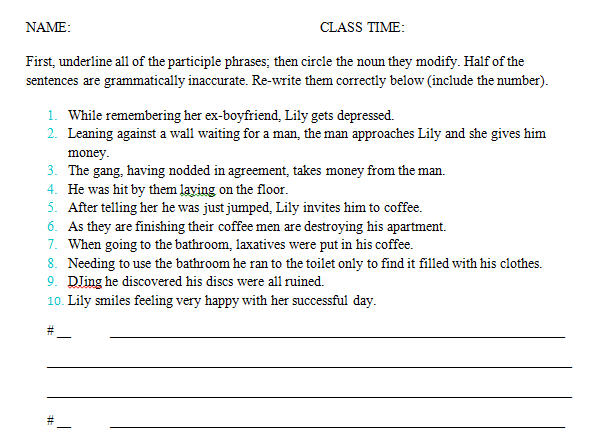
I took the lesson and changed it to be able to use a music video (we all know how I love music videos in class). I recently used "Earl had to die" in class to review Cause and Effect. A fellow teacher friends of mine who teaches the same level took the idea but used Lily Allen's smile. A video that I LOVE and am glad she reminded me of. So, this activity uses that:
First, students watch the video and we talk about getting revenge and such (which they like, as we seem to end up on this topic quite a lot).
NAME: CLASS TIME:
First, underline all of the participle phrases; then circle the noun they modify. Half of the sentences are grammatically inaccurate. Re-write them correctly below (include the number).
1. While remembering her ex-boyfriend, Lily gets depressed.
2. Leaning against a wall waiting for a man, the man approaches Lily and she gives him money.
3. The gang, having nodded in agreement, takes money from the man.
4. He was hit by them laying on the floor.
5. After telling her he was just jumped, Lily invites him to coffee.
6. As they are finishing their coffee men are destroying his apartment.
7. When going to the bathroom, laxatives were put in his coffee.
8. Needing to use the bathroom he ran to the toilet only to find it filled with his clothes.
9. DJing he discovered his discs were all ruined.
10. Lily smiles feeling very happy with her successful day.
# __ _____________________________________________________
# __ _____________________________________________________
# __ _____________________________________________________
# __ _____________________________________________________
# __ _____________________________________________________
Later students watched Daniel Poweter's Bad Day video and had to describe it using their own sentences. Some of them:
Closing his eyes he playes[sic] the piano.
Smiling she draws on the wall
Having a bad day he rolls out of bed.
Some of them used the lyrics and got pretty creative.
(Copy of the Lily Allen worksheet can be found here: http://busyteacher.org/8539-lily-allens-smile-and-participial-phrases.html )
Check me out! I am all official with a door nameplate-y thing
So I am here now in Culiacan.
I am currently going through the books and materials that I have and making the syllabusses for my classes.
The boring details I teach 4 classes a week:
2 at the high school (one at 8:30-10:00 MWF, the other at 10:30-12:00 MWF)
The view from my office...the fountains look better in person
AND
2 at the college (one at 7:00-8:30 MWF, the other 3:00-4:30 MWF)
There’s a small grace period, where I take roll 5 minutes AFTER class starts and I let students out 5 minute earlier.
I need to be on campus from 8-1, and 4-6. However, I get 3 hours to play with so later I can decide to show up later Tuesdays and Thursdays, and maybe get off early on Fridays. I still need to play with the schedule, but it seems OK.
So this is University/High School teaching in Mexico...for now
I was recently introduced to this great site by Sara Davilawho isaCirriculum builder (and has been for the past ten years!) she also does teacher training. She lived in Korea from 2002- 2010 as well as having worked in America which means she is familiar with plans that can be adapted to many cultures (key for me!). The main area where her materials are posted is here:
http://saradavila.com/front/?page_id=740
They are also clearly labeled based on level, type of activity etc.
For example, we all know I am a big fan of TBL, well she has quite a few options that have been tagged as TBL
Since I am heading to teaching college and high school I figured I'd look at some of her advanced activities.
This is the last day I will type from my school´s computers.
This year has been a whirlwind. I have learned so many things, improved my Spanish and made great friends.
I am looking forward to teaching at International House San Diego again this Summer, though I hope I can be a more successful teacher than last year.
I will miss...
The blank stares of stduents followed by , "Profe, que quapa hoy" (Teacher how beautiful you are today)
The random little one who runs up to me in the hall to tell me, "Profe, te quiero" (Teacher I love you)
Having them mix English in the most adorable way "I am my name is Marina" (Yes my college students may do this, but let´s face it it is cuter at 4)
Their excitement, "Profe, ayer you store cheese!!!!!!!!!!!!!!!" (Roughly Teacher, yesterday I saw you at the store buying cheese)
Towering above my stduents
The hugs
Singing and coloring about 80% of my class
"Baby Beluuuuuuuuuuuuuuga" (Really they are just adorable)
I will not miss...
"Profe Me hago piss" (Teacher I need to pee)
Little Ivan (3 years old) taking his penis out in the middle of class (though I will miss his honest to goodness face of, "what???")
Them complaining they are tired and can´t color (really, the hardest part of your day is staying within the lines...stop whining!)
That high pitched noise that comes from their mouth when they whine
Telling everyone to stop kissing each other during class
Never doing anything more complex than The Little Red Hen
The commute
I am very glad that this year gave me more patience, the ability to break things down, to really really learn my students level before giving an assignment, and some practical differentiation.
I know that because of this Masters and my year at the Colegio I should be a better teacher, now let´s see if I am.
Jo Millar was interesting since she has some experience teaching in Asia. I believe that teachers who have taught Europe as well as Asia always manage to have a slightly different methodology. This could be me making things up, but thus far it has been proven true.
So, she had taught in Vietnam for two years (and France) but now Spain is lucky enough to have her. She works in Alcobendas (all I actually know about that city is their handball and volleyball teams). According to the biodata she "completed the Delta and is particularly interested in collocation, learner autonomy and classroom management with young learners."
This is the powerpoint she used during her presentation.
Her chat basically talked about how ESL learners tend to say things that are grammatically correct but would never be said since they are the wrong collocation. Some examples:
We don't say: hard meat We say: tough meat We don't say: quick food We say: fast food We don't say: a fast meal We say: a quick meal
They come in many different forms:
Adjective+Noun like above Adverb + Adjective richly decorated (not richly painted) Noun + Noun loaf of break (not bar of bread) Noun + Verb builds a nest (not assembles a nest) Verb + Noun Make progress (not do progress) Verb + Expression With Preposition burst into tears (not appear into tears) Verb + Adverb Whispered softly (not whispered quietly)
There are two things to look at with collocations (Strength and Frequency). Collocations are important because they help student make predictions based on text (without having fully read it).
Example: It's the opportunity of a ...
Most people will guess lifetime, that's because this is a strong frequent collocation.
Collocations are useful because: predictions are useful and a real life activity (we don't actually listen to every word people day we fill in the gaps, chunks of language are more memorable than individual words, students fluency is increased as the language tends to sound more natural, and it can reduce the amount of direct translation a student uses.
She went on to give some practical ideas for using collocations in class:
Having a chart where students check off collocations that make sense (a super small example):
Food Shower Meal
Quick NO YES YES
Fast YES NO NO
Do a prediction with a text and then listen to it (focus on collocations)
So I snagged Paul's presentation from his blog, (which also states) that he is has, "recently become interested in using digital technologies with young learners with as a way to enhance motivation"
So basically his presentation talked about how to keep students motivated by using technology. He mentioned using things like twitter and making sure that students are a bit more in chagre or their class. So they can choose from a selection of pre-approved topics and the teacher can change the activities based on the student's needs.
To start the lesson We started with the normal hello song and reviewed the emotions, days etc. Then I showed them a picture of my friend Larry who is a leprechaun. We describe Larry and guess his favorite color and job (many students guessed things like miner or show maker). I explain Larry´s job is to protect the gold, so if you find it he will give you a wish to get it back. Then I show a picture of a rabbit who found the gold.
The story Once a rabbit found the Leprechauns gold. The leprechaun offered him anything he wanted. The rabbit said "I want a job" The Leprechaun said "1. 2 3 abracadabra and the rabbit turned into a _________" (the students guess the occupation based on the clothing, we then review the clothing). But the rabbit didn't´t want to be a _____, so the Leprechaun said "1, 2, 3 abracadabra" (repeat until all occupations are covered) Activity When the students are seated we look at the clothes for different occupations. Then we practice saying "I want to be a ______" and "I don´t want to be a _______" After the students, who were well behaved, can pick which coloring doll they want (but they have to ask in English). They ask lots of questions about which shorts to color etc so they also practice vocabulary. Not very complex, but good fun! For fast finishers they had to also color a leprechaun and paste the rabbit on the leprechaun page (make sure they draw a rainbow!) Clearly I meshed this with St. Patricks day but you could easily mesh it with an easter bunny who wants a new job or Cupid who lost his bow etc.
Elspeth Pollock noticed that having students take out their homework to correct as a class wasn´t actually getting her any results. So, she tries to make checking homework a bit more exciting with, "Correction Techniques: Keep your students awake."
In her own words (per the abstract) "In this workshop I’d like to show a variety of techniques for written and oral correction, using tools at our disposal from mini-whiteboards to technology (video, podcasts and IWB) to make correction both motivating and memorable."
Does she know what she´s talking about? Well, she, "has been teaching and training for 20 years and is Director of Studies at ELI, Seville. She has an MA in Linguistics (TESOL), the Cambridge DELTA and, most recently, the new ICT Trinity Certificate. She is currently interested in the integration of technology and teaching for all ages and levels of student."
Her main goal was to make the act of students giving answers more than just wondering around the class having students take turns. Some suggestions were:
Use a mini white board (laminate a green piece of paper)
Use little pieces of paper
Use Cuisinaire Rods (if its A hold up green, if B yellow if C orange etc)
Hide the answers under a chair and have students find it
Split up an answer sheet and give half to the first two students finished they can check the rest of the students (after they communicate with one another to figure out the complete answer set)
Make a wordle with all the correct answers and see if students can figure it out.
etc. etc.
Call me old fashioned but I always liked having students correct one another and then write their answers on the board, but it is always nice to have new experiences.
On the other hand if your classroom allows you to I don´t see why you couldn't just use something like surveymonkey and have students see the answers they all submitted anonymously of course, perhaps use it like a lifeline?
Nelson Arditto made a presentation about helping students memorize English words.
A bit more about Nelson, he "has been working in EFL for over 10 years and has taught in the UK, Syria, the UAE, the Ukraine, Jordan, Hong Kong and Spain. He has run a number of INSETT sessions for EFL and mainstream school teachers and participated in conferences nationwide."
His sessions (per the abstract, "This session highlights the importance of learner training in the successful learning of vocabulary. By the end of the session, teachers will be familiar with the concept of elaboration as a unique memory tool, and the ways in which teachers can introduce learning strategies to their students to make them more autonomous learners"
Since the English language has more words than any other language students need help when it comes to learning words. Since "lexical chunks" are easier to remember than individual words (which is why I have so many phrases in Dutch but slow on words)
He makes an argument for recording strategies in a notebook:
For example when writing down words you always write down words with a context.
Even more so in a notebook instead of just writing down the word with a translation you could do a lot more! Let´s look at the word strong:
Write down the synonyms and antonyms (powerful, weak)
Write the words connotation (positive)
The part of speech (adjective)
Collocations (strong flavor, strong drinks, strong swimmer, strong language etc)
Use it in a sentence (The strong man lifts weights every day)
Draw a picture
etc.
By doing this students will be more likely to remember the individual word since they have made so many different paths to it.
There were some different ideas of how to arrange this (alphabetically or by topic) and that probably depends based on your class.
What else would you have your students add to their word journal?
"Borja Uruñuela is Head of Education at St. James in Seville, where he has developed a language and content programme. He is also the President and head of training for ACEIA, and has written CLIL and social awareness material for Kid’s Box levels 1 - 4 (Cambridge University Press). He is also an oral examiner for the YLs Cambridge exams."
He talked about, "Motivation Theories in Practice" which was described in the abstract as, "When I think of motivation I think of Marslow, Herzberg, Alderfer but… what can we actually do to motivate our students? How can we motivate other teachers? How can we motivate ourselves when we feel demotivated? We will not focus on the theories but on practical activities we can do in the classroom and in the teachers’ room to increase people’s motivation."
He started by reminding us that Performance = Ability x Motivation
Goal setting is VERY important to a student's motivation. If they know where they are going then we can help them get there but, "I want to speak English better" is not a tangible goal! "I want to master the past tense in time for the exam" is specific and thus tangible and a good point to lead motivation!
The best goals are: specific, measurable, achievable, realistic, and time based.
Goals have to be discussed, public, and desired!
As a teacher we have to do more than teach, we also have to supervise:
Help set goals
Help create models
Give praise
Give rewards
Help evaluate (self, peer and formal)
Practice (give feedback and practice)
SELF EVALUATIONS
*Students do a test
*Teacher marks the tests
*Teacher goes through answers
*Students give themselves a mark
*Discussion
*Teacher gives out the tests
*How can I improve? Where did I go right? Where did you go wrong?