Analytics

Tuesday, June 12, 2012

Don't flip out! It is just a flipped class! (part1)

Notes regarding the last webinars I attended are still coming, but I managed to get some stuff in on Flipped classes today!

First I listened to Jon Bergmann and Aaron Sams talk about Flipped Classes in an ASCDWebinar, and here's what turned up :)

OK first let me say LOTS of people have said LOTS of things about flipped classes. They gave us a few links at the beginning, if you end up being interested or just have more questions you should really check them out!

Most people look at flipped classes as: "Classwork is done at home and homework is done at class" This is part of it, but they broke it down to some easy to see steps.

First off as a teacher you have to think. "What is the most valuable use of class time?"

For me, as an ESL teacher, it is speaking practice (pronunciation), them hearing native speakers, them getting to play with the language, writing, critical thinking and peer grading (which I standby as one of the best ways to learn).

To me, Aaron Sams said it best when he said, "We want students engaged in science, not listening in science." He admits that it started when he would record his lessons for his students. That way when someone missed class they could watch the class and catch up on the main ideas and then see the teacher with specific questions (YAY time savers)

In the end they decided to use the videos for the bottom two tiers of Bloom's Taxonomy (recollection and understanding) and trying to do the more complicated parts of Blooms together in class (analyzing, applying and evaluating) and possibly creating!

As a TBL lover this is great point. By moving the first two steps to home we have time in class to work on something more involved.

An important part to note is that the videos aren't always the first time the students see the information. Sometimes teachers give the videos at the start of a lesson. Other times they'll throw in in the middle. And yes, even sometimes at the end. The great thing is there's no WRONG way to do this!

Myths and Misconceptions:
  • Flipped classrooms are all about the videos. 
    • They are important to give you time to do COOL stuff, but they aren't the be all and end all of flipped classes. In some ways most upper division classes I've taken have been flipped. We were expected to do all the reading and research out of class so we could discuss and debate in class.
  • Flipped classroom relies on homework 
    • They suggested that you have stations, like in Elementary school, to avoid the homework concept. What about the Have vs. the Have Nots? Assign that homework to be done in school not at home just outside of the period (which is hard for athletes). Personally I think this part was a little weak and that with most of my students' schedules it would have to be done at home.
  • Flipped classrooms create a digital divide.
    • If a student doesn't have the internet you can put the videos on flash drives. If they have no computers you can burn the videos onto DVDs. The problems get bigger if you don't have a DVD burner, but you can write grants, ask the community for computer donations, ask a local tec company if anyone can refurbish some computers to help a school. Where there's a will there's a way!
  • Flipped classrooms propagate bad teaching (lectures). 
    • Lectures can be bad. They can be students falling asleep and teachers droning on and on, or they can be dynamic interactive classes. The same goes with videos. If we make interactive media rich videos then it is not encouraging bad teaching, it is giving us more time to teach in class while engaging students in a manner they are used to. They can be interactive. They are interesting. They are media rich for the YouTube generation.
  • Flipped teaching is only for math and science.
    • There's a PE teacher known as the flipped coach: Jason Hahnstadt. Basically, he feels that as a PE coach we spend too much time telling students how to move instead of them spending time moving. Check him out at FlippedCoach.com If you can do it with PE then you can do it with any subject! 
  • Flipped classrooms will solve all your problems and make your classes perfect.. 
    • It is NOT magic! As Jon Bergermann said, "It won't solve all of your problems in class. You still have to be a good teacher."
So what is it?
  • A tool in the tool box. It is a tool in the tool box that you can use when it works.
  • Use the idea as a stepping stone/bridge to make best combination of homework/classwork you can use with your students 
  • Try to think of a flipped classroom as flipping the attention away from the teacher and flipping the attention toward the student.
The webinar discussed how helpful it is for special ed students (since they can repeat the information as often as needed) however I don't have special ed students so I didn't focus so much on that part.

Problems?
  • What about students who can't learn from videos? (We recognize there are different learners)
    • Basically this allows students to use the videos as one way to learn, but allowing them to have others if needed. Basically it is applying self-differentiation. You assign tons of options of how they can get the knowledge and then they choose what works best for them.
  • You can also apply this to students' assessments. Students need different ways to represent that they have learned something. (It's why I give 5-7 different assignments for short stories and allow students to pick 3)
  • What about the kid who doesn't watch the video?
    • No magic bullet, this is just like every student who doesn't do homework.
    • Some teachers have students watch in the back and they just miss out on in class time.
So how can you easily flip your class?
My great IH San Diego students flipped!
  • Flip assessments
  • Flip the tools (iMovie, Prize, etc.)
  • I see myself flipping
    • Essay structure
    • Grammar points
    • Some of my TOEFL lessons
How long will it take to flip a school?
I thought this was interesting to note:

The first year: You will be working on something new, but keep at it!
The second year: You will have some bugs, yet things will be getting better.
The third year: Almost there you'll just be getting rid of some wrinkles.
By the end of the third year: Everyone will know that this is just the way things are done.

Overall
Well it was nice to hear from teachers and see the questions other teachers had. Parts of the flipped classroom seem appealing, and while I don't think I would flip my whole class I may flip a lesson or two along the way. 

The mentioned their book is out so if flipping classes is something you want to learn more about you may like to check it out.

(I found another webinar the same day! If you want to hear what I learned from a teacher using this now check it out here 

Have you had a chance to try flipping classes? What do you think? Or why haven't you done it yet?

Friday, June 8, 2012

My students are not the best inferrers

My TOEFL students REALLY struggled with inference in Wednesdays lesson so I gave them a quick worksheet with simple sentences and then asked them to infer. 
  •  Example: "Oh honey you don't have to get be anything for my birthday, just being with you is enough. I am going to go to the store now. I hope that my purse doesn't fall apart on the way there. It is so old!"
  • Inference: The person would like a purse for their birthday.
They struggled a little, but they improved a lot! They helped each other and when they were stuck I asked questions:
  • Example: An older man is running behind a school bus waving a child's lunch box in the air
Me: When do you run?
Students: To stay fit. Because you are late. To get away from someone etc.

Me: Is the man working out?
Students: No, he has a lunch box.
Me: Why would he run with a lunch box?
Students: He needs to give it to someone
Me: Whom might he need to give it to?
  • Inference: The man's child is on the bus and has forgotten his lunch.
One of the statements was:  You are giving a presentation for a large audience, and you notice people are laughing quietly at you while they point to the region below your belt.

My students had NO idea. I even had a volunteer come to the front of the class and stand there while I pointed at his general groin area. They were clueless! Once I explained it they all understood, but I was amazed no one got it.

I talked to my boss and a few other people and they got it right away... I wonder why they had so much trouble.

Do you get it?

Thursday, June 7, 2012

My online gradebook

Dear EnGrade.

I think I love you. I have always kept very detailed grades. I always send students updates of their grades about once every other week. I also send students notes about their missing work and how to turn it in for late credit. I check out where student's are struggling and e-mail them extra help.

I did it without you for many years, and I did it just fine. Though it was sometimes hard to convert my spreadsheet language into something easy for others to read. Now, I do it all with you and I am never not understood.

Now, I keep all my classes organized and can give access to students and their parents.

In addition to helping me keep track of grade you also do the work of blackboard! You can load the applicable worksheets, assignments, links, etc.

You can assign work as missing, or excused! Meaning there's no re-evaluating percentages or totals if a student missed a day due to a school activity and doesn't need to make it up (or I in my case since I allow students to be "excused" if they have family emergencies).

I won't say that you save me THAT much time, my excel sheets always worked very well for me, but these are easy for OTHER people to read. So when a counselor, parent or student doesn't understand someones grade I just print a summary and there is no debate!

And of course! The price is right (viva free).

I am so in love with you that I recommend you to all my friends, and I hope that you stay with me for a long long time.

Much love,

Carissa

Great video for If...

When I start each class I pass out a "getting to know you," worksheet. One of the things I ask is what television shows they like. That way I can use their TV shows in class. This class likes the Big Bang Theory, and I was lucky enough to find this great clip online using 2nd Conditionals. 


I used this video with my students today to practice for the TOEFL, and (to make it more interactive) we practiced making conditionals WITHOUT if by using Subject verb inversions.

It worked really well. The students worked in teams, and at the end the team with the most right answers won.
 

I stopped at 2:48 as after that they get a bit too long and slightly more complicated.
 
For example: 
If that were a movie I would go see it. 
turns into
Were that a movie I would go see it.
 and
If I were to ask Leslie Winkle out it would just be for dinner.  
turns into
Were I to ask Leslie Winkle out it would just be for dinner.

Wednesday, June 6, 2012

The trouble with suffixes

June 4th my students had their first Partial Exam. Since we started class with the test we ended it with a pretty easy suffix and prefix activity. We went over some suffixes(ship, ful, etc.) and prefixes (hetero, arch, etc.) and then I gave them a bunch of root words: friend, bishop, chamber, sex, etc. I paused before writing sex on the board, but I wanted something that would go easily with hetero.

The assignment was to come up with as many words as they could combining the root words, prefixes and suffixes.

I told them that we would go over the answers at the end, and if they weren't 100% certain it was a word just guess! It was mainly important that they came up with new meanings.

As they are making their lists I get a lot of, "Teacher is ________ a word" to which I responded, "We'll go over them at the end. Just guess!" Class continued, but I kept getting the same question. In the end I started abbreviating my answer to, "maybe"

I get the question from a group of boys,
Students: "Teacher is _____ a word?"
Me: "Maybe"
Student A: "She said maybe. That means yes"

Really guys? Maybe means yes?

Me: "I am not sure what girls you have dated, but that's not how it works

They were amused and finally stopped asking!

They continued working on the list and one of my sweetest most hardworking students asks, "Teacher... is sexship a word?"

It is on Urbandictionary, and I've seen it on twitter, but it has yet to become mainstreamed. I just quietly asked her "what type of relationships do you normally have?"

She turned bright red, "no no, teacher not me"

Tuesday, June 5, 2012

Common Core State Standards: Where Does Differentiation Fit?

Just a quick notice that tomorrow there is a Webinar on differentiation. It was one of the areas of education I was most into during my Masters (other than Papiamentu) and I admit I have strayed away from it a bit this year.

The Webinar will take place Wednesday, June 6th 3:00PM-4:00PM EDT.
 Per the ASCD website: 

"Curriculum, assessment, and instruction create a system of interdependent parts. Bring the standards and curriculum to life by using differentiated instruction methodologies to maximize the capacity of each learner. By the end of this webinar, presented by Carol Ann Tomlinson and Sherida Britt, participants will be able to
• explain why common core calls for attention to student differences.
• determine the ways differentiation supports the instructional shifts of the common core."

You can register here: https://www1.gotomeeting.com/register/855280081

Hope to see you there!

Friday, June 1, 2012

Oh no! Poor Joe... body parts game

I just got an e-mail from a friend the other day that she was using a body part game I introduced to her which the kids ALWAYS love, so I figured I'd share it.

It's one of those great games that doesn't actually require much set up. I have used it with older students, but I'll walk through the little kiddie one and you can change it as you wish.

In all fairness I snagged the concept from a scene in the movie Dave

The students at this point have normally learned, "Hello," "My name is" "What's your name" and "How are you today" along with some emotions. The next unit is normally body parts soo...here we are.

First, I tell them I want them to meet a friend of mine. What do we do when we meet a friend?  Eventually some student says, "Say Hello" or "What's your name." As they are guessing, I draw my friend on the board (you can draw a whole body for other body parts, but my paint skills are lacking so I just did the face here):


My friend Joe
Teacher: "Do we know his name?"
Students: "Nooo"

Teacher: "How do we ask?"
Students"Hi, What's your name"

Teacher, "My name's Joe"
Students, "How are you today?"
Teacher. "I am not feeling well"


Teacher "Repeat after me: Oh No!"
Students "Oh No"

Teacher "Poor Joe"
Students "Poor Joe"

Teacher "He has no"
Students "He has no"

My friend missing something
***erase a  body part****
 
Teacher: "What is Joe missing?"
Students: "Ears!"
Teacher: "Great, so all together:

Students and Teacher: "Oh no, poor Joe he has no ears!"

***Draw the ears back on and repeat erasing a different body part***

When your students get the hang of the chant (which they LOVE) see if you can get them involved!

Have them come up in from of the class and "become" Joe. They will practice introductions again, (Hi, what's your name? My name is Joe. How are you? etc.) Then the student should turn AWAY from the rest of the class. The class starts, "Oh no! Poor Joe, he has no..." and then the student turns around, only this time the student is covering something (eyes, ears, mouth, elbows...I've had students tuck their hands into jackets or arms into shirts) the students quickly pick out what is missing and finish the chant.

This is a quickly made example of the beat with the words. Students really don't care how well drawn Joe is!


This game can be altered to use powerpoint, prezi, posterboards, hand made cards, etc. I've seen it done very nicely with large cards here. It can be used with clothes (Oh no poor Joe, he has no scarf!). Though if you use clothes, be sure to bring in extras so you don't have students taking off their pants in class. You can make handouts with the pre-written chant, "Oh no! Poor Joe, he has no _______" and have students fill in the blanks and draw a picture. Really it is just a great springboard or wrap-up.

You can download the directions for class and a quick worksheet for your students for $1 just check my store on TPT if you aren't already signed up you can do that here)

Anyways, this game has helped me with lots of classes (and relentless random children at banks) so hopefully someone else can use it too.

Do you have a go-to game that is little to no prep for if you get called in to sub a class? Or you need to fill up an extra ten minutes at the end? The other one I love is flyswatter, but I think most teachers use that.

BONUS: I just made a new version for Winter. check out, "Oh No, Poor Snow"

Thursday, May 31, 2012

Pinterest to get teaching ideas

That lovely bunch of smiley faces is my family. Four of the eight adults are or have been English Teachers. So usually when I hit a brick wall or need help on a topic I pull an E.T. and call home.

However, the internet has truely changed how I can react. There is help all over the place, though I still call my mother quite often. While most of my friends plan their upcoming weddings (real or imaginary) on pinterest I tend to find the some great teaching ideas and graphics on pinterest...and what an easy way to organize them!


For example I have a bunch of pictures/comics related to punctuation: http://pinterest.com/carisita/punctuation/ some of them I have found and some of them I have raided of other people's pinterest boards.

So I can divide things up by category: Grammar, Basic things related to being an English Teacher

I also have board for each of the classes I teach so later I don't need to remember what that article I used last year was, or where I found that great comic that one time.

Topics I teach in my TOEFL class, or my Advanced I class.

Anytime someone likes or Re-Pins one of my suggestions I get told. That is helpful since most people who like things that I like are probably collecting things that I can also use in my classes!

Do you use pinterest? Should I be raiding your board? Please let me know if there's anything about Pinterest you that I am missing!

Wednesday, May 30, 2012

Reading Materials for Free!


I am not always lucky enough to have books with me
I don't have a bookshelf that travels with me from location to location, but I always try to give my students varied reading choices regardless of the empty shelves! I can have access to so many stories with the click of a mouse.

Magazines, blogs and newspapers are all an awesome source of reading materials, but sometimes it is nice to have something a bit more permanent. When you change age groups as much as I did it is nice to know that there are some free reading sources you can legally get (I can't very well discipline at students for plagiarizing if I don't keep to the same moral code)! Following is a quick non-comprehensive list of sites I have found helpful for reading materials.


If you teach the younger crowd check out WeGiveBooks. I would have KILLED to have known about this site when I was teaching pre-school and kindergarten (or even when I au-paired in the Netherlands). In addition to free e-books (many of them popular children's books not just similar characters doing similar things) when you finish reading a book you can click to donate a book! As a San Diego girl I LOVE that the San Diego Padres are behind this. How great is that?! They also have resources for teachers (everyone from pre-school to 12th grade!) So to summarize, you get free books, you get to help out people who also need free books, AND the Padres rock :) 

  • Wily Writers is a place I have found some great short stories. My favorite part is that you can normally contact the authors to let them know that you are using their story. Sometimes they will answer questions from your students, other times you can set up a skype date. If nothing else you can have students e-mail them a thank you. For example I was lucky enough to find Jess Hartley who has written some great short stories we used in my class and was kind enough to chat with my students! More on that here. They also quite often have the audio version of the story.
  • Free-e-books well with a name like this there isn't much left to the imagination. With a bigger focus on newer e-books this site is a nice way to find some modern examples of English for students to read.They have "educational" books, general non fictionhumor, short stories, and young adult. With so many options there has to be something that works for you.
  • NEW (added 6/16) Smashwords is a site I was just introduced to and it is AWESOME. It has books for sale as well as freebies. They seem to add new books every day for a constant supply of good reads.
  • NEW (added 3/15/2013Flip Builder  is a cute java site that has people actually "turning" pages. Not everything is free but the collection for little ones is pretty cute!
Made for Teachers
  • ESLMonkeys is a great site as well! A lot of the books are resource books, and there are a bunch of dead links but there's also some great interactive reading sites linked (Ghost Forest has a trailer to entice you into reading more.) ESLMonkeys also links to a short story by Robert Norris who in addition to selling his story as an e-book, a podcast and in print offers it to teachers and students for free online! The Many Roads to Japan: A Search for Identity is about John Banks and how he ends up in Japan. Basically the site has tons of fun free stories that English Language learners are sure to find interesting.
     
  • ELCivics isn't my favorite but for newer teachers who aren't comfortable enough working with authentic materials it offers 3 easy to use books with quick short stories and comprehension questions. It looks like it is designed for lower intermediate adults, but it is definitely worth a look.
  • Teachers Pay Teachers has 2,972 Guided Reading worksheets right now. 349 of which are free! They have every age level up to worksheets for adults. Similar to BusyTeacher these often contain built in activities as well! If you don't already have an account you can go straight to their sign-up page here
  • BusyTeacher Many teachers share not only worksheets but graded readers, short stories, magazine articles, etc. Often they even include activities. 
CLASSICS:

Most of these you can access with any normal computer, however I know that reading tablets are all the rage now. My friend has a kindle and swears by it so you may want to consider the investment.

Where do you go to find reading? Do you use more magazines and articles or do you prefer books?

Monday, May 28, 2012

Summer TOEFL

Oh TOEFL TOEFL TOEFL. Well, this year I have taught my first TOEFL class ever. It went... well. The class was a TOEFL class and a writing class. Not as many students passed as we would have liked, so when I give the class again in the Summer it will just a be a TOEFL course.

I am in the process of re-writing the course (with supplementary materials to make a 3 hour daily TOEFL course slightly less boring)

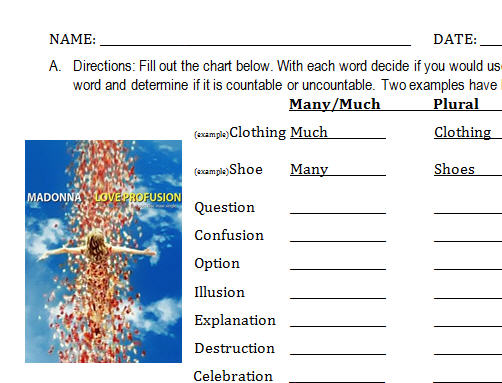
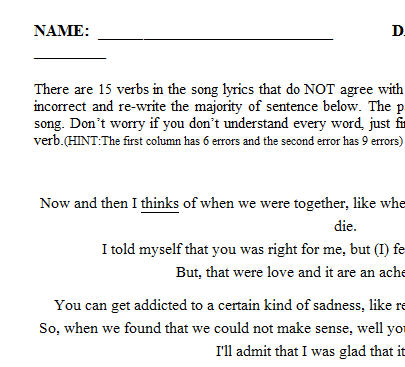
I am trying to add some songs whenever possible Madonna's Love Profusion for when we review uncountable nouns (and more importantly the quantifiers that go with them) and mainly because I LOVE the music video "5 people 1 guitar" I used Somebody that I used to know for Subject / Verb agreement.

Hopefully this Summer goes well!

Friday, May 25, 2012

Idioms

To all teachers of idioms.

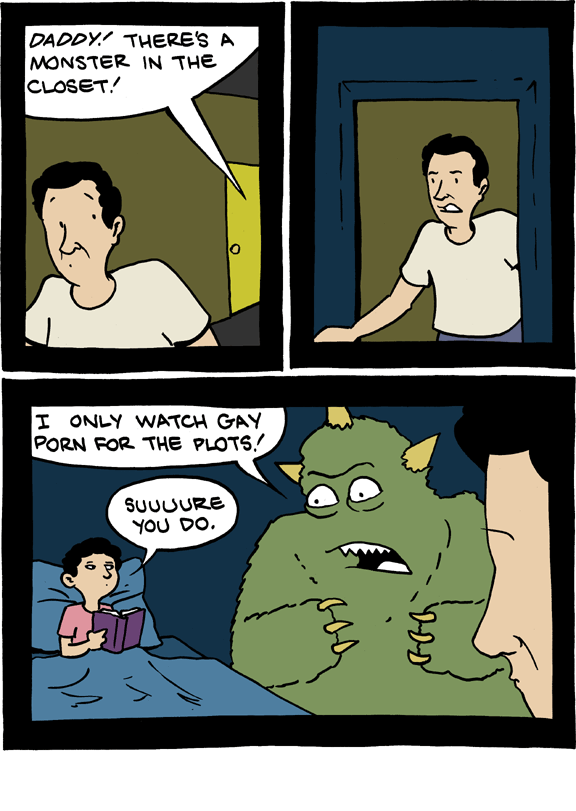
Idioms can be confusing. Is a Monster in the closet literally... or figuratively? And what does it mean figuratievly anyways?

My students are actually pretty good at these (YAY for one thing I don't need to review for this Summer's TOEFL course) but what I really like about this site is the ability to find idioms in other languages.

This way you can give students an example of something that is not literal in their language (compared to a direct translation of the english idiom).

Yes yes I know I know avoid translations when possible, but this is something I have found that really helps students understand the concept behind idioms rather than just memorizing words which don't seem to make sense.

The site: http://www.idiomizer.com/idioms/

Let me know how you teach idioms or what you think of the site!

Or try using dictoglosses, movies, songs or any other vocabulary trick if translating rubs you the wrong way.

Friday, May 18, 2012

2nd Evaluation

Well I improved! That's always a good thing :)

My boss actually came into my office yesterday to tell me that my evaluations this time had improved. I wouldn't be able to view the evaluations until the 18th, but he just wanted to let me know.

That took some pressure off me and I was not dreading reading my evaluations.

My 7am/3pm classes were a little mixed. They felt that since they needed a good TOEFL grade to pass they should have had more TOEFL practice. We did do TOEFL practice, buta lot of it was "hidden" in other activities. We also did lots of reading, but it wasn't multiple choice TOEFL style.

Anyways, we decided the students are right and we are changing the class to be more TOEFL based. Most the reviews were pretty generic:

"Fun class, i like to go..she makes interesting the class." 

"Sus clases son muy dinamicas, lo que convierte a la materia en una clase interesante y motivadora." 

"muy buena maestra, buenas clases,comprensible y buena para enseñar."

"Excellent! Teacher maybe i really don't love your explanations buy i love the way we practiced all, you put a lot of time to plained our class, i think you were my best english teacher ever! i've learned more english in this class than in all my life really! but all depends about my toefl score, that is the bad thing :c jajajaja but i really will miss you"

"I love this class. Just one thing i do not like; take the class in the afternoon is so annoying. But the class is ok." 
 
Those made me happy since I do try to make class interesting.

My 8:30 class had a lot of duplicates. A few chatty students, but overall I think they did well:

"Nice teacher just a little weird"

"Excelente teacher, me gustan sus clases, siento que pasan bien rápido, me divierto y aprendo."
 
"A very good teacher. The best teacher in the ITESM."

"Excelente profesora, aunque puede llegar a aplicar metodos poco ortodoxos alguna vez, es capaz de llegar a nosotros los jovenes para poder aprender de una manera mas esencial y no solo por 'machetear'."

and finally

"Hello Carissa, you´re a great teacher, although you scream often, it´s okay, because your class is better that way. You´re class is very fun, we always do different things and try to support us in every way. Thanks for the consult, we´ll meet again at you´re office ;)"

So I am improving...I suppose that's good ... though now I am a bit nervous about continuing to improve, I suppose I can just keep trying the hardest that I can. 

Thursday, January 5, 2012

Relative Clause Cheat Sheet

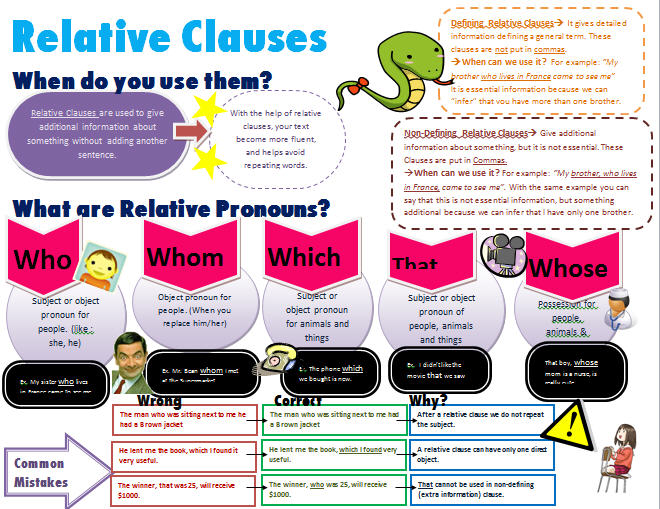
My final assignment for my Lengua Extranjera class was to make a cheat sheet for something we had covered. One student did a fantastic job! She made a relative clause sheet that reviewed the basics. I uploaded it to busyteacher (I love this site!).

Check it out, or leave a comment and I'll e-mail it to you if you have problems with the busyteacher site.  

Monday, December 12, 2011

How to assess writing? With rubrics, duh! (Sara Weigle)

So as discussed in the prior post the LARC has had webinars about assessment in the past. There was also a TOEFL Spain presentation on the different ways to assess homework.

Well this time I had the change to listen to Susan Weigle discuss assessing writing. You can read more about her and the webinar here: http://larc.sdsu.edu/webinar-sara-weigle/ She is a published and respected teacher, but this was her first webinar, and it showed. I am not honestly sure I would recommend watching the recording to anyone, but you can find it linked above. AGAIN Sara is very qualified, but the webinar appeared to be a bit too much. She was often overwhelmed and honestly I struggled to get through the presentation. Participants as well seemed to be clueing out and asking questions that she had already answered. No worries, everyone struggles their first time and I am sure she will improve with each webinar.

So, she started by going into the basics of writing, authentic writing tasks versus the tasks where we use writing to check grammar or vocab comprehension. For me this was a reminder that whenever possible we should try to keep our assignments as authentic as possible (kinda hard given I am currently teaching academic writing, but still).

Then she discussed Hamp-Lyons definition of a writing test:
  1. Test takers must write one piece of continuous text
  2. Test takers are given a prompt or instructions on what to write
  3. Writing is evaluated by at least one trained grader
  4. Graders judge using a rubric or set scale
  5. Judgments are given as numbers or grades
How can writing be assessed without being tested?
Webinar participants suggested logs, journals, timed writings, chat forums, portfolios, essays, fb group discussions, etc I would actually argue that many of these fall in the definition of the writing test per above, but I suppose it depends on if a rubric is used or not (I use them with every assignment I give for consistency). Sara goes to specifically define a test as an in class timed writing, compared to take home essays.

Then she discusses the components of a test, the task (what they should write) and the scale (how we grade it).

She gave us the topics (http://www2.gsu.edu/~wwwrtp/topics.htm) that University students have to write on to prove they are university level writers. Most of the webinar agreed that for high school or EFL learners the topics were fine but they were a bit too broad for an academic timed writing.

To avoid having a task that doesn’t meet up with the students’ (or teacher’s) needs it is important to remember the principles for task design.
  1. Clarity Students need to understand what they are doing (a colleague of mine discussed an exam the other day where she asked students to write on one of the topics in the box below. She also reminded them to use good grammar and watch their spelling. Several students wrote on why using spelling and grammar is appropriate. This is the result of unclear topics(or students who don’t pay attention) )
  2. Validity It should be a writing that is relevant.
  3. Reliable the task should elicit writing samples that can be scored consistently
  4. Interest the task should be interesting to writers and readers (not another opinion paper on abortion PLEASE)
OK, so now we have our pretty task, but how do we grade it? Well, RUBRICS!
I liked one ”pro” about Rubrics that she mentioned: It is important to, “make implicit assumptions and goals explicit” this lets students better prepare since they know exactly what the teacher wants. As a teacher we may think it is OBVIOUS we want out students to use cause and effect linkers as we have studied them for the past 3 months, but if you don’t specifically say it (and let the students know) I promise you most students will not assume this.

Why else are rubrics amazing? You can share them with your department for some consistency amoung all the classes, and when the students see them they cannot claim favoritism or “the teacher doesn’t like me” they are specifically given their grades with what they didn’t or did do.
Now the type of rubric that I do is analytic which means I score on several dimensions. This is normally easier for new teachers (I guess I fit that stereotype) and in gives students a clearer idea of where they need to focus more energy next time.
  • For example a paragraph could be graded on mechanics, transition words, organization and format. All of these are totaled for a final grade.
This is compared to holistic where the paragraph is grades on one “standard”:
  • Example: The paragraph is grammatically correct, with good transition words and is organized. 90pts
  • The paragraph is grammatically OK, with some transition words and is organized. 75pts
  • Etc.
DESIGNING RUBRICS
  1. Define according to the topic, process and the product
  2. Determine the components that you are interested in
  3. Decide on what TYPE of rubric you want
  4. Define components
  5. Decide on number of score levels (generaly 4.5)
  6. Write descriptions for each score level. Look at existing rubrics for ideas!
I am always up for a good online tool and this time she have us: http://rubistar.4teachers.org/ I tend to do my rubrics by “hand” but I do think that some assignments could be OK with an automatically generated

Brief sidenote: she did throw in her two cents on peer grading (that the grader usually benefits more than the gradee). Which I have always felt so it was nice to hear :)

Head, Shoulders Knees and Toes...with Clothes!

My students always LOVED head, shoulders, knees and toes, and I always loved it since it was really heavy in the TPR area. Sadly, there are only so many times a student can learn the parts of the body. So, I changed the song a little for studying clothes. They still got a kick out of it and it is a great wintery activity (that doesn't touch on the religous aspects of winter) that keeps them moving (and is still a great Total Physcial Response. song)


I prefer teaching trousers since pants has a different meaning in England, but to each their own. Feel free to teach pants, jeans, or whatever else. If you choose a one syllable word I reccommend adding an "and" to keep the beat.

This could also be adapting to Summer (Cap, sunscreen, shorts, sandals... glasses, hair tie, chapstick, ... ideas for nose?)

Happy Holidays! You can download the directions for class and a quick worksheet for your students for free just check my store on 9th, 10th, 11th, 12th, Higher Education, Babies/Toddlers - ESL / ELL / EFL, English - TeachersPayTeachers.com

Saturday, December 10, 2011

Focus on the good :)

So, I am done with my first semester here at Tec de Monterey. Overall I think I picked up some bad habits from Spain (yelling at students), but I do feel like some of the Masters classes paid off (my worksheets are much prettier now).

I also got frusterated A LOT with the fact my college students behave worse than my pre-schoolers last year...but I guess that just calls for an adjustment of standards.

As far as evaluations my college classes tended to be pretty tight lipped, one student complained of too many essay, but that really isn't anything I can control. Otherwise mainly smiley faces and such. The two "best" I think were:

"Tiene un carácter fuerte pero se llevo bien el curso" - Lengua Extranjera
"
Muy exigente en cuanto a calificaciones pero muy buena maestra." - Lengua Extranjera
The next class was my hardest class to teach, I got a few flat out rude comments from them, but in the end I am tuning those out and focusing on the good:

"
MUY BUENA MAESTRA, LE AGRADEZCO MUCHO POR TODAS LAS ASESORIAS QUE OFRECIO Y POR LA FORMA DE ENSEÑAR, ME CAYO MUY BIEN." - English VI

"
Esta profesora marco un punto en mi aprendizaje de la lengua Ingles porque esta maestra nos pedia el maximo y gracias a ella aprendi lo que es ser un buen alumno" - English VI

"
Muy buena maestra, atiende muy bien a sus alumnos si le piden ayuda fuera de clases" - English VI

"
Muy buena maestra, estuvo padre la experiencia al tener una maestra extranjera, diferente al metodo de los maestros en mexico, encantado llevo otra clase con ella." English VI
From my other high school class:

"
Very nice teacher, always trying for her students to learn and improve their skills and abilities during the course. Congratulations, i wish you great success during your life. Was great having classes with you, i would like to be in your class again."

AND probably the most well written constructive comment (that pretty much sums up my own personal self reflection (from the same class as above):

"Es una persona con un sistema de enseñanza distinto, me agrada su clase y aprendo mucho, pero le hace falta un poco de tacto, aveces suele ser sarcastica."

So, that's where I am now. Looking forward to next semester where I will try to tone down the saracasm and yelling at my students.

Monday, December 5, 2011

Opinion Paragraph with Lyrics

I am starting to plan for next semester and am kinda excited about the first assignment. The students will be writing a paragraph to support an alternative interpretation of a song.

I was partially inspired by this interpretation of Rebecca Black's song Friday


So I wrote up a quick paragraph (which will be edited thoroughly and used as the sample paragraph for the students)

“Friday” has important historical references
Rebecca Black’s song Friday is about the tensions in The United States of America in the 1950 and the 1960s. The 1950s and 1960s in the United States were a tense time of the Cold War, presidential assassinations, and racial segregation. First, Rebecca Black focusses a great deal of her song to discussing which seat she should take, indicative of racial segregation. In the 1950s and 1960s The United States employed racial segregation in many parts of life, but this was seen especially in public transportation; people were told where to sit based on their race. Most memorably Rosa Parks, the mother of the freedom movement, refused to give up her seat to a white woman in 1955. She made a stand on which seat she took, and Rebecca obviously alludes to this here. Another point is Rebecca says that everyone needs to “Get down on Friday,” referencing the assassination of John Kennedy on Friday, November 22, 1963. When there is a shooting the first thing people will scream, to decrease unnecessary casualties, is “get down.” The assassination was a tense moment in American life making people feel depressed, or “down,” just as the song suggests everyone felt that Friday. Finally, Rebecca has a line in which many feel she says, “Everybody is rushing,” this however is actually her hinting at “Everybody is Russian.” The cold war with Russia was a big deal in America and many Americans were falsely accused of being Russian. In the 1950s McCarthyism swept through the country and simply by being Russian, or labeled as a communist, many people were blacklisted from their jobs. Thus Rebecca Black’s Friday is a song that does more than just invite people to enjoy the weekend, it also speaks to the tumultuous times of the United States in the 1950s and 1960s.

Assignment. Write a paragraph in which you express and support a unique interpretation of a song.
Examples:
_____ is about an alien abduction _____ is a song written about a pet not a boyfriend.
_____ is about open heart surgery. _____ is about Mexico earning its independence.
o ANY interpretation on ANY English song it is OK as long as it is unique:
GOOD:) Christina Aguilera’s “Reflection” is about a transsexual who is not accepted by his family.
BAD:( Christina Aguilera’s “Reflection” is about a girl who doesn’t fit in.
GOOD:) Aladdin’s, “A whole new world,” is about someone who has been diagnosed with cancer.
BAD :( Aladdin’s, “A whole new world,”is about a couple exploring a new place.

Hopefully I get some decent reads, I think most English teachers will vouch that someitmes the hardest part of grading is reading the same boring papers over and over again.

EDIT Oct-18: I've done this three times now and it has worked really well! Some fun examples from students:
"The Lion sleeps tonight" is about a woman in an abusive relationship.
"The Lazy song" is about a man sufferring from depression due to the eocnomy.
"Never gonna give you up" is about the the United States Cold War with Russia.
"Call me Maybe" is about a lady with crush on a married man.

You can purchase the whole kit and caboodle on Teachers Pay Teachers for the bargain price of $1
http://www.teacherspayteachers.com/Product/Paragraph-Assignment-to-Interpret-Songs  (if you don't have an account yet you can sign up here)

Have you had a chance to use songs in any way like this? How have your students found it?

Friday, November 25, 2011

Kiss for Peace

Most people have heard about Free Hugs, but not many people have tried kisses for peace.

When most people hear of Culiacan they immediately think of the drugs and violence associated with the city's cartel. Despite the fact that Culiacan is trying to build up a thriving art culture that gets roughly no focus. SUMA helps! SUMA is a private institution established in 2007, that promotes citizens to get involved in a legal and healthy relationship with the city.

In this case they promoted a Kiss a Day for Peace


Tuesday, October 18, 2011

Participial Phrases

I was reviewing the wonderful world of participial phrases for class on Friday and I came across this gem: Movie Segments to Assess Grammar Goals

I took the lesson and changed it to be able to use a music video (we all know how I love music videos in class). I recently used "Earl had to die" in class to review Cause and Effect. A fellow teacher friends of mine who teaches the same level took the idea but used Lily Allen's smile. A video that I LOVE and am glad she reminded me of. So, this activity uses that:


First, students watch the video and we talk about getting revenge and such (which they like, as we seem to end up on this topic quite a lot).

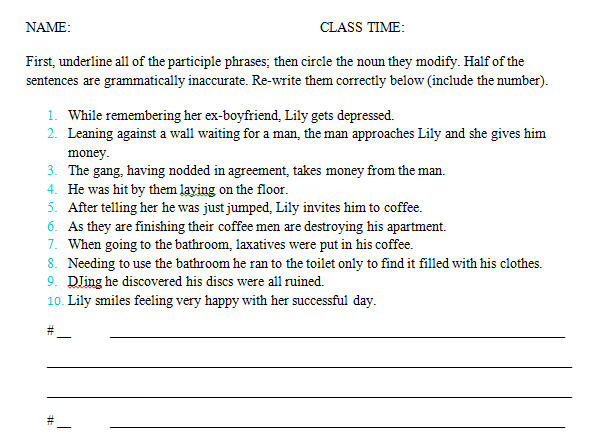
NAME: CLASS TIME:
First, underline all of the participle phrases; then circle the noun they modify. Half of the sentences are grammatically inaccurate. Re-write them correctly below (include the number).
1. While remembering her ex-boyfriend, Lily gets depressed.
2. Leaning against a wall waiting for a man, the man approaches Lily and she gives him money.
3. The gang, having nodded in agreement, takes money from the man.
4. He was hit by them laying on the floor.
5. After telling her he was just jumped, Lily invites him to coffee.
6. As they are finishing their coffee men are destroying his apartment.
7. When going to the bathroom, laxatives were put in his coffee.
8. Needing to use the bathroom he ran to the toilet only to find it filled with his clothes.
9. DJing he discovered his discs were all ruined.
10. Lily smiles feeling very happy with her successful day.
# __ _____________________________________________________
# __ _____________________________________________________
# __ _____________________________________________________
# __ _____________________________________________________
# __ _____________________________________________________

Later students watched Daniel Poweter's Bad Day video and had to describe it using their own sentences. Some of them:

Closing his eyes he playes[sic] the piano.
Smiling she draws on the wall
Having a bad day he rolls out of bed.

Some of them used the lyrics and got pretty creative.

(Copy of the Lily Allen worksheet can be found here: http://busyteacher.org/8539-lily-allens-smile-and-participial-phrases.html )

Friday, July 29, 2011

The job

Check me out! I am all official with a door nameplate-y thing
So I am here now in Culiacan.

I am currently going through the books and materials that I have and making the syllabusses for my classes.

The boring details I teach 4 classes a week:

2 at the high school (one at 8:30-10:00 MWF, the other at 10:30-12:00 MWF)

The view from my office...the fountains look better in person
AND

2 at the college (one at 7:00-8:30 MWF, the other 3:00-4:30 MWF)

There’s a small grace period, where I take roll 5 minutes AFTER class starts and I let students out 5 minute earlier.

I need to be on campus from 8-1, and 4-6. However, I get 3 hours to play with so later I can decide to show up later Tuesdays and Thursdays, and maybe get off early on Fridays. I still need to play with the schedule, but it seems OK.

So this is University/High School teaching in Mexico...for now
Related Posts Plugin for WordPress, Blogger...