There's always that great go-to assignment whenever you need a no prep activity. You have one student say/write the start of a story, "Once upon a time there were three beautiful butterflies."Then the next student would continue the story, "They wanted to be explore the world, but they were afraid their wings wouldn't fly."
I am going to discuss three reasons I love this app for my students, and a few ways I think you can use it, and include a video showing you how it works.
1. I hate to say it, but the app is free. When you use as many different apps as I do in class it can be tough to charge students all the time. So, when you find a great free app, it kinda feels like you won the lottery.
2. It is offered on iTune and Google Play. My classes are about equally divided between Mac lovers and Mac haters, so having an app that works on both devices is great.
3. It is ridiculously user friendly. A fast sign up and voila, you're ready to get creative. Also, because the stories are so short, students shouldn't get overwhelmed.
As far as how to use it:
1. Have students collaborate to make stories. Then vote on the best.
2. Have students select their favorite quotes from a text that you are reading in class to start an Alula. See how others change the meaning from the original text.
3. Have students pick a story that they like and make it longer on their own.
4. Choose a story that has some errors and have students correct it.
5. And more!
What's it look like? Check out:
Analytics
Showing posts with label Short Story. Show all posts
Wednesday, January 21, 2015
Tuesday, May 6, 2014
Blackout Poetry / Found Poetry: A fun activity!
Have you ever made extra copies? Ended up with 25 worksheets you never got to do in class? Had a random flu bug hit your class and end up with 10 copies too many? With papers printed on only one side I usually just keep a stack and use them later when I am copying something new. However when they are double sided what can you do?
There is an activity I like to give my fast finishers, though sometimes we do this as a class when working on poetry. When someone finished early I give them an old worksheet and have them make a story or a poem out of it.
If we are studying a particular grammar point I may ask them to include that, but normally I don't.
It is basically a fun and pretty way to have students write without writing.

Optional (Pre Step):
The first time you do these in class you may want to show some examples first. One famous "blackout poet" is Austin Kleon. He has a book Newspaper Blackout
available as a paper book or an ebook. You can also find his poems online (he's on Twitter and Instagram). His poetry is very simple, you essentially black out the words you don't want. He uses newspapers (which is also an option!), but you can apply the same concepts to old worksheets.

Step 1.
Give them an old worksheet. In this case it is a TOEFL diagnostic test. My school often asks me to give these workshops, but since I never know how many students will attend I normally have extras.
Step 2.
Have students underline (in pencil) words that they know. The great thing about this task is even if they only understand 10% of the words that's fine! They don't need to understand everything.
Step 3.
See if they can create a poem or story with the words they know.
OPTIONS!
For punctuation practice I like to have them re-write their poems and punctuate them properly in the margin. Punctuation often adds extra meaning to their words.
As far as appearances, you have some choices:
A. Students can black out the words they won't use. (or use any color they like!)
You need fun questions.
How can rhyme help you?
When poems work well.
Pictures must use your friends in public.
You can create, copy, open, clip, web, graph.
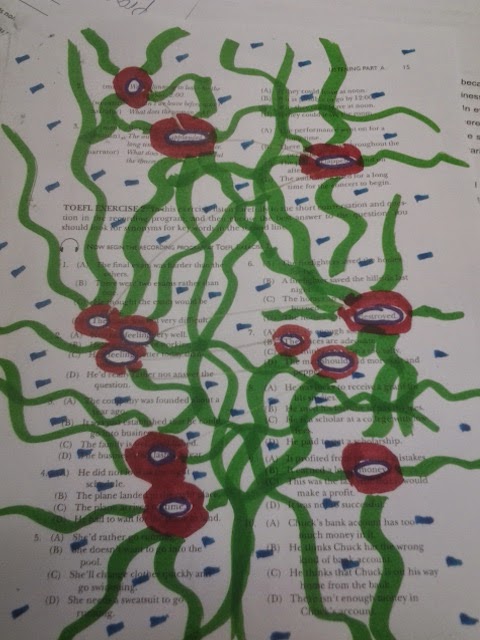
B. Students can draw lines connecting the words and decorate the page as they like.
We applauded, clapped.
The feeling destroyed.
The feeling should last: money, time.
C. Students can create art over the words.
Essentially, she creates a blank slate by having students paint white over the words they will not use. Once dried they draw a picture that they feel connects to the story. I do not do this in my class as I don't normally have access to paints, water, etc. However, if you are in an art friendly environment, it could be something to consider.
There are tons of ways to reuse old worksheets, but this is another one to add to your list. Plus, it is fun!
What's your favorite way to reuse paper?
There is an activity I like to give my fast finishers, though sometimes we do this as a class when working on poetry. When someone finished early I give them an old worksheet and have them make a story or a poem out of it.
If we are studying a particular grammar point I may ask them to include that, but normally I don't.
It is basically a fun and pretty way to have students write without writing.
Optional (Pre Step):
The first time you do these in class you may want to show some examples first. One famous "blackout poet" is Austin Kleon. He has a book Newspaper Blackout
![]() |
| Unused Worksheet |
Give them an old worksheet. In this case it is a TOEFL diagnostic test. My school often asks me to give these workshops, but since I never know how many students will attend I normally have extras.
Step 2.
Have students underline (in pencil) words that they know. The great thing about this task is even if they only understand 10% of the words that's fine! They don't need to understand everything.
Step 3.
See if they can create a poem or story with the words they know.
OPTIONS!
For punctuation practice I like to have them re-write their poems and punctuate them properly in the margin. Punctuation often adds extra meaning to their words.
As far as appearances, you have some choices:
A. Students can black out the words they won't use. (or use any color they like!)You need fun questions.
How can rhyme help you?
When poems work well.
Pictures must use your friends in public.
You can create, copy, open, clip, web, graph.
B. Students can draw lines connecting the words and decorate the page as they like.
We applauded, clapped.
The feeling destroyed.
The feeling should last: money, time.
C. Students can create art over the words.
Essentially, she creates a blank slate by having students paint white over the words they will not use. Once dried they draw a picture that they feel connects to the story. I do not do this in my class as I don't normally have access to paints, water, etc. However, if you are in an art friendly environment, it could be something to consider.
There are tons of ways to reuse old worksheets, but this is another one to add to your list. Plus, it is fun!
What's your favorite way to reuse paper?
Subscribe to:
Posts (Atom)