Analytics

Showing posts with label Grammar. Show all posts

Sunday, July 9, 2017

Using tech to help students review their writing


One of my big focuses as a teacher is giving students tools they can use without me. I've given many students checklists and models that they have later thanked me for as they used them throughout many later classes.

Besides those paper tools, I also give my students some electronic tools for reviewing their papers, e-mails, articles and really any written work. None of these are a replacement for a second set of eyes, but it is nice to have technology help out.

Most of these are Freemium meaning they offer services for free, but offer more or better services (without advertisements, less wait, etc.)

Below I'll give links and brief descriptions to four sites I give my students. Try them out with your own writing and share them with your students! I bet one or two of them will thank you.


1. Grammarly

If you sign up here you get to try Premium for a week (full disclosure I get a free week if you sign up with this link). Premium is nice, but I find the free version is definitely great too.

There's a Grammarly browser add-on (for Chrome, Firefox or Safari), a Microsoft Word add-on, and students can go to the site and copy and paste text to check it.

My favorite part though, is the weekly e-mails students get. Grammarly sends an e-mail once a week that lays out spelling and grammar issues they encounter most often.

Students can combine this with NoRedInk and practice any grammar skills they still struggle with on their own.

2. PaperRater

This site does have a lot of ads, but it's a great time to teach some digital citizenship in being careful what you click on. Students copy their text and then go to PaperRater. Once there, they paste their text into PaperRater filling out their specifics (type of text, grade level, etc.). The site looks at several different elements: Spelling, Grammar, Word Choice, Style, Vocabulary and Words. Then it gives a grade.

Obviously, this isn't perfect! For style it looks a lot at transitional phrases. For Word Choice it basically identifies words like "a lot, I don't, big, don't, get, really, many, am, go, most" and reminds students to consider other words or use a thesaurus.

A big thing to go over with students is that the grade is automated and that it definitely isn't a crystal ball that will predict that grade they earn.

3. Hemingway Editor
Reminding students that bigger isn't always better, Hemingway looks at sentence length, adverb usage, passive voice, and just awkward phrases to make writing easier to read.

While PaperRater also looks at sentence structure, most students get focused on the spelling, grammar, and grade. Hemingway focuses exclusively on structure. Spelling and grammar errors are irrelevant.

Hemingway Editor is definitely a site worth introducing to students. There is a time and a place for adverbs, passive voice and complex sentences, but this site's easy color coding can help students see if they have too many of one color populating their essay.

4. The Writer's Diet
Last but not least, there's The Writer's Diet. Based on the book by the same name, the site encourages writers to have "fit" writing rather than "flabby" writing.

After copying and pasting a text, students' are given a bar chart detailing a breakdown of their text and then the text itself.

There you are! Four more digital tools that students can store in their toolbox.

I am always sure to discuss all of these with my students. In fact often when first introducing them I have them run their text through and make changes. Then they give me a little write-up  which site they used, what was helpful, and what was not so helpful. This helps build a critical eye and students get an idea of when to use which site.

These are meant to be helpful tools, but they should be used with a critical eye. These are all automated and none of them perfect!

Do you know of any others I should add to my list? Have any experience you'd like to share? Let me know in the comments!

Wednesday, May 27, 2015

Speed Dating

Here are my students during their most recent speed dating class

Speed dating is not a new trick for teachers. I used to use it a lot for class warm ups or bell ringers. The assignment varies a bit, but essentially, students talk and listen to a partner for a set period of time, then they switch partners and repeat.

Types of Assignments
This works well for grammar or vocabulary practice. These can be the same story thing and over, or you can give each partner a card with a different question. For example, I could have each students give a mini biography of themselves to practice  simple past tense: I grew up in San Diego, I went to Santa Sophia Academy, etc. Or, I could have each student have a question that they ask their partner. Some may ask about family, others about travels, etc.

In the picture above my Speech students are working on practicing their historical speeches (students were each given a speech to memorize and present to the class) Since they didn't need to write a speech, they could focus on tone, gestures, volume, etc This was a great way to have a lot of them practice to new listeners rather than listen to the same speech over and over.

Pros

It is different! Some students may get nervous when they see the new seats (even if they knew it was coming), but in the end something new is good for their neurons and their interest in the class.

It is rather hands off. As a teacher I can walk around and watch almost all of the students. They require very little interaction from me.

It is fast paced. Students don't get bored. They are always on the move.

Cons
For the most part this can be adapted to any number, but on occasion I have an assignment where I need it to work with an even number. In this case, I put a desk in the middle and have a student practice on their own, or work on a reflection. In one case I used it as a chance to have quick mini-conferences with that student.

It doesn't lend itself to an "in-n-out" class. By that I mean, if you have students who are coming in late, or being pulled out in the middle of your class it really messes up the flow of class. Try to keep this for a day that you think things will run pretty smoothly.

Tips and Tricks
Have fun with it! Before starting have students sit in front of the class and play "charades." Have them pick dating faux pas like texting on a date, talking over your date, falling asleep on your date, not making eye contact, etc. Include some positive things as well: leaning forward, smiling, nodding your head, etc. Students will love watching one another ham it up in front of the class, and you'll be able to have good behaviors modeled and encouraged.

Give the listener a reason to listen. Either let them know that they will be telling about what they hear, they will be tested on it, or they will need to evaluate their partners. Something to keep them accountable. Real speed dates usually end with people turning in requests for dates, so why not have your students turn in whether or not they'd want to hear the speech again with a quick reason why.

I set up the tables before the students arrive. I put two different colors of tape on the board with numbers with a note to grab a number and sit in the matching seat. This isn't really needed but I find, "inner circle" and "outer circle" confuse the students, but if I say, "read tape" and "blue tape," then they all get it immediately.

Keep everyone moving! Normally in speed dating one group of people (e.g. ladies) will stay seated the whole time while others will rotate around them. My students are all equally antsy. To keep people seeing different partners, I alternate rotations Those on the inside of the circle rotate to counterclockwise one time, and the next time the outer circle moves clockwise.

Concluding Remarks
This is a great highly active way to practice...and we know so much of language and speaking is "Practice, Practice Practice"  
A photo posted by carissa (@clarissasinel) on


Does anyone else use speed dating in their class? Do you have any other suggestions, tips or tricks? Comment below or let me know on Twitter or Facebook.

Monday, September 1, 2014

Book Review: The English Tenses

Tenses can be tricky!
This review is late. I read this book about a month ago and had a review written up to auto publish about two weeks ago. Unfortunately, due to the magic elves that live in my computer. I have no idea where the original review went, and I've been very busy with school lately and unable to write a new one. Apologies again to author Phil Williams for this delay.

The English Tenses Practical Grammar Guide is not a book I would suggest students or teachers read from start to finish (though you certainly could). I would suggest that teachers keep this on hand to review before teaching a specific tense (or to brush up if they are teaching a new level). I would also encourage advanced students who learn well independently to consult this book to help them grapple with English tenses.

Basically, this would be a great addition for any English teacher's bookcase.

This book goes into a detailed description of the differences between all the different tenses of past, present and future. Seriously, all of them. Go to the link I gave above (or click on the book cover below) and check out the, "look inside" function Amazon gives. You'll be able to peruse the very detailed table of contents to get an idea of exactly what is in the book.

To the left you'll see a quick example of the table of contents with all of the different information is has on past tense! This repeats for the future and present tense as well.

Each section includes an explanation and the basic rules of the specific form in question. Then, Phil goes over the affirmative, interrogative, negative and negative question forms using multiple different examples and charts to make it clear what part of the sentence correlates to previous examples.

As a paperback, this book is under $25. If you read books on your tablet, kindle or online, then you can download the Kindle version for less than $7.00! It has AT LEAST 100 pages of solid information on tenses sure to clarify this topic to anyone who reads it.

Overall I'd encourage you to add this book to your wishlist. If you do get a chance to read it, or have a different text you'd recommend let me know in the comments.


Wednesday, August 13, 2014

Have Students Write Letters

The picture is from Danny's FaceBook page DannysWarriors
One morning I was skimming my Facebook newsfeed before I went to work when I saw a picture of a smiling little boy! Danny Nickerson looks just like so many five year olds I know. He has large twinkling eyes and a goofy smiling grin. Unfortunately, Danny isn't just any five year old. He has an inoperable brain tumor.

Like so many other children, his family is trying to do all they can do to keep him happy He doesn't want to go to an amusement park, pet a lion, or be a super hero. He wants to get birthday mail. When someone wants something this small, it seems ridiculous not to help out!

At the start of my class on Wednesday I told the students about Danny and asked if they wanted to take a few minutes to make him some cards. If you have a stricter schedule, and need to keep this relevant to a grammar point you could easily do relative clauses, "I hope that you enjoy dogs. They're the only animal that I can draw." modal verbs, "You should have fun," or superlatives, "You are the strongest person I know!" etc. I let my students write whatever they wanted, and some of them folded origami. 

Now, Danny's birthday was July 25th. I am sure belated cards will also be accepted, but there are other alternatives as well!

You can always contact a local hospital and try to find an address that would work best, but here are some addresses I have collected for you:

Write a Letter of Gratitude to a Veteran thanking them for all they did for our country.Thank a Veteran
c/o Penny Alfonso
1970 Rangeview Drive
Glendale, CA 91201

If you would like to send letters specifically for our Wounded Heroes, please send them in a separate envelope marked: Wounded Warriors.
Operation Gratitude
17330 Victory Blvd
Van Nuys, CA 91406

Girls Love Mail sends letters to women going through breast cancer treatment. All letters must fit in the Girls Love Mail envelope (4.75" x 6.5"). They also have a kit for teachers

They ask that you include your full name and return address on the mailing envelope. They send thank you emails to acknowledge that they received letters.
 
Girls Love Mail
2330 E. Bidwell Street, Suite 200
Folsom, California 95630

St Judes Hopsital is a research hospital where you can send cards to the children. You may send them to: 501 St. Jude Place, Memphis, TN 38105

Find Pals has you sort through many patients to find a specific one to send letters.

Send Kids the World works well and they have lesson plans

Depending on whom you choose to write to and how old your students are, you may want to go over brief etiquette.  For example, "Get better soon!," while a nice sentiment, is not the best thing to say to a child suffering from  cancer. Have your students brainstorm phrases that they can use and should avoid before hand.

These aren't always penpal services... in fact usually you won't get messages back. However, that's  a good lesson too! After all, only doing something when you expect something in return isn't the best lesson to teach our students.

Wednesday, July 31, 2013

Funny Sketch About Different English Learners' Problems


This is a fun sketch that goes over the different problems a student may have in a class.

One student struggles with grammar! This is the students I would be most like. With a student weak in grammar I suggest lots of reading, movies, fun drills, and maybe some grammar comics

There's another student who is pretty bad at spelling (and thus pronunciation!). There are a few great sites out there if your students can't spell, but I usually know a few good spelling tricks to help out students.

The next student struggles with idioms and proverbs. If you can find these in songs or movies it may help your students remember them.

The final girl has large problems with her vocabulary. There's an entire MOOC going on right now on how to teach vocabulary. I have an older blog post that covers some basic suggestions for activities, games, and quizzes.

And the last student struggles with emphasizing words (and vowel sounds). I am pretty bad with pronunciation other than using minimal pairs and jokes. but the 34th ELT Blog Carnival has given me many more ideas to work with.

The Carnival will be published on September 1st, so all submissions must be received before August 31st.

See http://eslcarissa.blogspot.mx/2013/07/the-34th-elt-blog-carnival-pronunciation.html for more information.

Monday, December 24, 2012

Another Comic for Your / You're

The other day I was arranging to get together with a guy friend via text message. 

While we are not romantically involved at all from time to time our conversation definitely gets flirty. This was one of those times. 

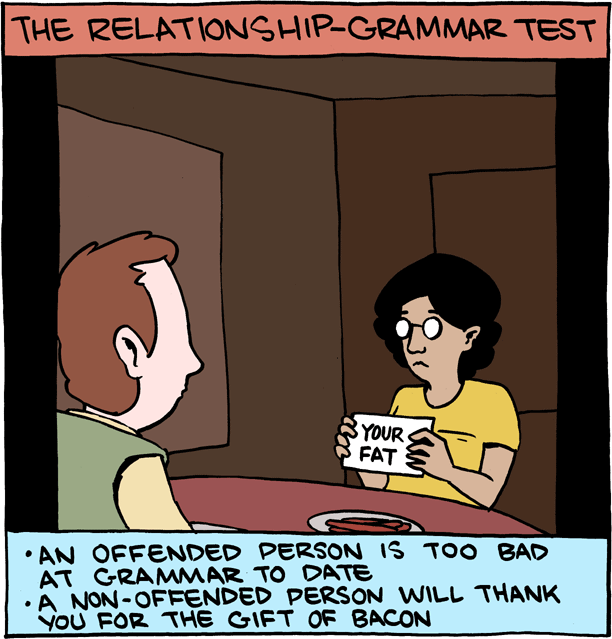
At some point in the banter he ended up using the wrong your and I instantly found him less attractive. 

Does that make me a grammar snob? Perhaps, but that doesn't make it any less true. 

This grammar comic is a good example of what I may want to implement in the future for your vs you're (and perhaps a helpful reminder to your students).

Tuesday, October 9, 2012

Whose whom is whose? (or is it who?)

The easiest way, for me, to help students remember who, whom and whose is to outline the differences on a chart. I tell them that Who,Whom, and Whose each have a matching pronoun.

Who is used in cases where the answer is He, She, or They.
Ke$ha, who spells her name with a dollar sign, sings songs. Who sings songs? SHE sings songs!

Katy Perry, who kissed a girl, had Ke$ha in her music video. Who kissed a girl? SHE kissed a girl!

Whom is used where the answer is Him, Her, or Them.
This is easy to remember because the m in whom matched the m in Him and Them (females as usual complicate things).

Ke$ha, whom is loved by many, sings songs.
Whom do they love? Many love HER!


Whose is used for the answer His, Hers or Theirs.
This is easy to remember because of the S in whose and his, hers and theirs.


Ke$ha, whose song “Boots and Boys” is my favorite, sings songs.
Whose song is it? The song is HERS.

Katy Perry, whose music videos are popular, had Ke$ha in her music video.
Whose music videos are popular? HERS are popular.


So that's what I find the easiest way to remember when to use what. However, some students work better if they know the rules.

WHO is used when the person is the subject of the verb. The person is doing the action.
Ke$ha, who dances, loves boots and boys. (SHE dances)
Ke$ha, who is crazy, loves boots and boys. (SHE is crazy)
Ke$ha, who rocks, loves boots and boys. (SHE rocks)
Ke$ha, who parties hard, loves boots and boys. (SHE parties hard)
Ke$ha,who doesn't like James VanDerBeek loves boots and boys. (SHE doesn't like James)
etc.
In all of those cases Ke$ha is the subject.

WHOM is used with the person is the object. They are receiving the action.
Ke$ha, whom I love, loves boots and boys. (I love HER. She doesn't love me)
Ke$ha, whom James VanDerBeek fights, loves boots and boys. (James VanDerBeek fights HER. We don't know yet if she fights him back.)
Ke$ha, whom my neighbors found drunk in their bathtub, loves boots and boys. (My neighbors found HER. Ke$ha didn't find them.)
Ke$ha,whom my priest never listens to, loves boots and boys. (My priest never listens to HER. We don't know if she listens to the priest.)
etc.

WHOSE is used to show possession.
Ke$ha, whose teeth wish she would stop using booze to brush them, loves boots and boys. (The teeth are HERS)
Ke$ha, whose album sold more than mine, loves boots and boys. (The album that's HERS sold more)
Ke$ha, whose love of singing shows, loves boots and boys. (The love of singing is HERS)
Ke$ha, whose mother was a singer, loves boots and boys. (The mother is HERS)
Ke$ha,whose outfits in music videos are always fun, loves boots and boys. (The outfits are HERS)
etc.

One last thing.

Who and Whom are only used for people...with a few exceptions. Depending on your love for animals many people use who(m) for pets. I have seen some people take this so far as to use it for all animals, but usually that isn't the case.

Rarely, for poetic license, countries or cities will use who or whom.

So that's it. Now you know all there is about who, whose and whom. The only thing left is to review the difference between defining and non-defining clauses (check out which vs that for more on those).

What activities can be done to review these with a class? One that works well is to find a brief news article and have students combine the sentences. This also lends itself easily to flyswatter (just write the relative pronouns on the board). It would work better if you could use a smartboard or similar so you could have the words move every turn (since there are so few). 

What activities do you use to have students practice who, whom and whose? 

Monday, September 17, 2012

Reviewing Your vs You're with your class

I know that apostrophes should only be used to show possession or in contractions, yet when I am typing I often throw in extra needless apostrophes out of habit.

In the same way, most students know the difference between you're and your, they just get overwhelmed when writing and make the mistake without thinking.

So, how to get students to use your and you're properly?

First make sure they know the difference. The Internet is fantastic here. There are grammar comics, songs, and websites that point out the difference as well as many memes. Find some funny examples and come up with some on your own if need be. Check out the Venn diagram on the right for a basic guide on the differences and similarities between you're and your.

Check that they understand by giving them some sentences and having them explain what it means. You can use YouTube clips to make this a bit more fun, or just say them yourself. For example.

“'You're the one that I want' did I mean you are or your?”

What does: Your "you're" you're using may be wrong mean?
The “you're” that belongs to you that you are using may be wrong

It can also help to compare it to similar word pairs in English. He's vs His (which sounds similar), or She's vs Her, I'm vs. My and finally It's vs Its (which has its own set of problems).

Remember: “Good grammar is the difference between thinking 'You're tops' and 'Your tops'.”

Next, discourage contractions. When speaking we use contractions naturally, and that's fine since you don't have to worry about pronouncing your differently than you're. Informal writing also tends to have contractions; however try to encourage students to write out words in full whenever possible. This tends to be the fastest way to get rid of this mistake as they won't likely use “you are” when they mean to say “your” and vice versa.

If that doesn't work, or your students are disinclined to write out entire words make sure they double check their work out loud. I try to avoid grading written work around people as I end up reading their essays out loud. That's because I can hear mistakes more clearly than I can read them. If your students read their work out loud and read contractions in full (so they would see can't but read cannot) they will likely find all their mistakes. If their brains keep auto-correcting their mistakes, have them read backwards, starting with the last sentence .

Activities! 
This opens itself up to SO many games! It can be done with flyswatter. Just put Your and You're on the board. It works even better if you rotate which word is where and you only have two groups. Say a sentence, “Your shirt is ugly” and then have the students race to hit the correct word. In this case hitting the wrong word would result in the other team getting the point.

This also works very well with dictoglosses since students would have to figure out if your or you're made more grammatical sense.

What activity would you do to review? What tips do you have when teaching the differences?

Tuesday, August 28, 2012

Why grammar comics are amazing...and where to find them

Comics are awesome.

They just are.

They make students laugh (always a plus) help visual learners, and tend to have very succinct summarizations of otherwise complicated grammar topics.

If nothing else, they give examples that grab student's attention.

But where to find these miraculous creatures?

You can always resort to google. Just google the grammar topic and comic and then click on images. If you need help Googling check out this link.

The downside is that you tend to get a lot of stock images and irrelevant pictures.

I tend to read http://xkcd.com/ and http://www.smbc-comics.com/ every day and Pin comics that I know will work well for me, my classes or topics that come up a lot.

I also keep up on http://www.9gag.com/ as they tend to have a lot of good stuff on you vs your, they're vs their and other common mistakes that your students will relate to (and have probably already seen as they love 9gag)

The comic above is from Boggleton, who has grammar comics involving misused words and participial phrases as well as full on grammar explanations.

Otherwise some sites have specific sections for grammar comics. The oatmeal has some nice full on grammar explanations; such as, how to use a semicolon.

I talked about GrammarCat before. There aren't a lot of strips, but the ones that are there are good.

BrightlyWound is no longer updated, but it does have a collection of grammar comics.

This bitstrips comic has some great grammar reviews

My students just used The Yuniversity, which I decided to look up and was super pleased to see that they have some awesome explanations that students would surely find more interesting than a simple list.
Related Posts Plugin for WordPress, Blogger...