Analytics

Showing posts with label Ecology. Show all posts

Tuesday, May 6, 2014

Blackout Poetry / Found Poetry: A fun activity!

Have you ever made extra copies? Ended up with 25 worksheets you never got to do in class? Had a random flu bug hit your class and end up with 10 copies too many? With papers printed on only one side I usually just keep a stack and use them later when I am copying something new. However when they are double sided what can you do?

There is an activity I like to give my fast finishers, though sometimes we do this as a class when working on poetry. When someone finished early I give them an old worksheet and have them make a story or a poem out of it.

If we are studying a particular grammar point I may ask them to include that, but normally I don't.

It is basically a fun and pretty way to have students write without writing.


Optional (Pre Step):
The first time you do these in class you may want to show some examples first. One famous "blackout poet" is Austin Kleon. He has a book Newspaper Blackout available as a paper book or an ebook. You can also find his poems online (he's on Twitter and Instagram). His poetry is very simple, you essentially black out the words you don't want. He uses newspapers (which is also an option!), but you can apply the same concepts to old worksheets.


Unused Worksheet
Step 1. 
Give them an old worksheet. In this case it is a TOEFL diagnostic test. My school often asks me to give these workshops, but since I never know how many students will attend I normally have extras.

Step 2. 
Have students underline (in pencil) words that they know. The great thing about this task is even if they only understand 10% of the words that's fine! They don't need to understand everything.

Step 3. 
See if they can create a poem or story with the words they know.

OPTIONS!
For punctuation practice I like to have them re-write their poems and punctuate them properly in the margin. Punctuation often adds extra meaning to their words.

As far as appearances, you have some choices:

A. Students can black out the words they won't use. (or use any color they like!)

You need fun questions.

How can rhyme help you?

When poems work well.


Pictures must use your friends in public.

You can create, copy, open, clip, web, graph.
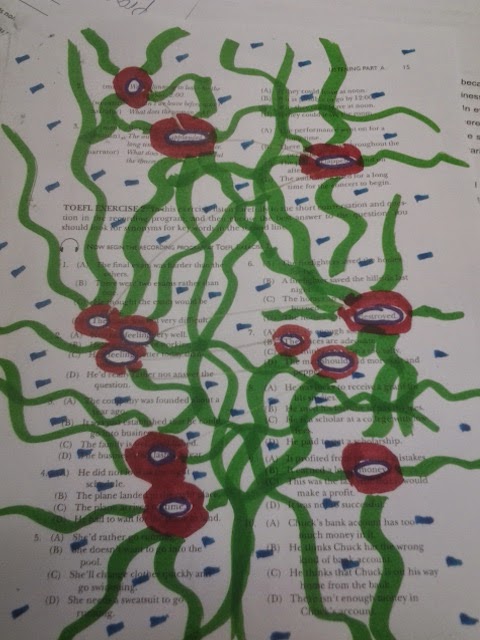
B. Students can draw lines connecting the words and decorate the page as they like.

We applauded, clapped.

The feeling destroyed.

The feeling should last: money, time.

C. Students can create art over the words.
Essentially, she creates a blank slate by having students paint white over the words they will not use. Once dried they draw a picture that they feel connects to the story. I do not do this in my class as I don't normally have access to paints, water, etc. However, if you are in an art friendly environment, it could be something to consider.

There are tons of ways to reuse old worksheets, but this is another one to add to your list. Plus, it is fun!

What's your favorite way to reuse paper?

Wednesday, February 26, 2014

Here's another Water Freebie!


Since I just posted about the UNICEF mobile site to donatewater and keep students off their phone, I thought I should share this great ebook about different ways to get your students thinking about water.

 The book is designed for teachers in London: however, most of the activities can easily be adapted to the city where you teach. Some of them are obviously English related: write a story about a river in the shape of a river for example, but other activities that aren’t English based are great examples of tasks you can use for task based lessons.

 Keep in mind that Earth Day is coming up in the spring, so if you are planning to incorporate anything about water conservation into a lesson later, it may be best to introduce something water related now. This way when you teach water conservation later, they will be able to refer to the earlier lesson.
For example, students can animate the water cycle (MEW010) and focus on a specific tense. Alternatively, students can focus on the use of transition words.
There’s another activity where students go online and try to track specifically where the water in the school (or house) comes from. Then they track the path via the pipes to their house. This should give them appreciation of how far their water travels.

A lot of science experiments are great for getting students to talk to one another, write down their thoughts and then share them with the class. For instance, you can have students make a water filter and try to filter water you have made dirty. Later they can present their filter to the class and hypothesize what could have made it better.

Was every mission great? No. A few flat out would not work in my area. For example. When they suggest counting rain drops left on cardboard, they are envisioning a rain that doesn't come down in sheets the way it usually does in Culiacan. Bu that's fine! There are more than enough suggestions, so I can ignore the ones that don't work for my class and adapt the ones that may.

The book overall is well written. It is NOT written specifically for an English Language Teacher, but if you are like me, then you are used to adapting lessons all the time! Plus, this book has super cute illustrations by Tom Morgan Jones

There's also a version of the book for students without all the teacher's notes.

I saved the best part for last! There's a related website MissionExplore.net
At this site teachers (or students) can sign up and start earning basges! It is all in Beta right now, but it looks like LOTS of fun and a great way to keep students engaged and maybe get the competitive ones really working hard!

Thursday, February 20, 2014

Keep students off their phones, and help a child access water at the same time!

I love technology. I often have lessons where my students use their cell phone or tablet in class. I think there are a lot of apps that give us the ability to really make students excited about class. However, not every lesson uses cell phones!

Do your students always pick up their phones in the middle of class? They want to be sure they don't have a new tweet, or see what their favorite celebrity is saying on Facebook. Sure, sometimes you can make it a teaching moment, but usually it just distracts them, the rest of the class and you!

Here's an idea. You can make not touching their phone into a game AND teach them about the importance of water.


UNICEF, with their sponsor Giorgio Armani Fragrances, is helping us realize that we don't need to be on the phone all the time.

To participate simply get on your phone and visit http://tap.unicefusa.org/. It will give you specific directions. Basically: 1. Set your phone down. 2. Don't touch it.

If you can make it for ten minutes without touching your phone, they donate a day of clean water to a child in need.

While you are not touching your phone the app keeps a timer letting you know how long you have gone. It also gives you random facts about water, or the Tap Project.

OK, that's nice, but what makes it a game?

It gives you specific goals. Compares your "score" to the score of other users, and showing you your own personal records! This is an easy and fun way to keep your students from touching their phones.

I won't use it every class, but it would be fun to see how much water a class could "earn" by simply staying off their cell phones during class time. If you have a lesson on resources or water this is pretty much the perfect addition to your class.

While the app is up and running now, the fine print suggests that only minutes done between March 1st and March 31st will count. Therefore, if you are planning on making this into a lesson, you have about a week to plan something amazing.

There are a few things to be aware of: It WILL drain battery and use internet, so be sure they have an awesome plan, or are tapping into a local WIFI source.

Try it out and let me know what you think! If you are looking for other water saving activities check out this post about MissionExplore!
Related Posts Plugin for WordPress, Blogger...