Analytics

Showing posts with label ELL. Show all posts

Saturday, January 7, 2017

Create Class Culture and Flush Regrets Down the Toilet


To start this activity students entered class with a "to do" list on the board. Each student desk had two markers and two to three squares of toilet paper.

Step 1. The "To Do list" on the board had four steps
  • Sit where there is toilet paper (do NOT, crumple, play, or blow your nose with it)
  • 2016 review
  • Field Trip
  • Start 2017
Students took their seats and I explained that I know a lot of them had an amazing 2016, whereas others may have some regrets.


I showed them my piece of toilet paper which said "Procrastination." I explained that procrastination was a real regret of mine and I felt that if I had managed my time better, then I would have had a better 2016. As a result, this year I vowed to get started on things as soon as they were assigned.

Step 2. 

I gave students some time to write down their own regrets and then they had the option to share. Students were invited to share as much or as little as they wanted. Some students talked for quite a bit, and others shared just a word or two.

As they shared, I'd ask who felt similarly, and what solutions we could offer that would help all students.

This is an important part because we are building a class of empathy and helping. We relate to one another and our struggles and share our experiences to improve everyone's life.


Examples:
  • They regret eating so much junk food
    • Eat more food from home.
    • Bring less money to school
  • They regret not doing their homework
    • Actually writing down assignments in their planners
  • A few of my exchange students regret choosing to study abroad. (sad!)
    • We talked about why they regretted it. They missed their family. Speaking in English all the time was hard. While some students had some advice, I think overall it was a good chance for them to empathize with another student.
  • Less social media
    • I shared a few add-ons that I like (like Dayboard which makes them achieve five things before they can access social media)
Step 3. Field Trip!
We headed to the unisex bathrooms right by my class. Everyone tossed their regrets in the toilet and we literally flushed them away.

Step 4. Returning to class, I asked them to remember this and try to stay focused on making 2017 the best time ever!

I love this activity because it's quick, memorable, students love it, it helped build classroom culture, and it was an easy way to ease students back into the classroom after two weeks off for Christmas break.

I encourage you to give this it try in your class. No need to wait until January 2018 to use this in class. Give it a shot after a rough week, a bad unit, or any other time you just want to help students turn over a new leaf.

Saturday, February 21, 2015

Audio Book Quizzes

I usually share links to audiobooks as well. We read a lot in class, so I know they are practicing that skill, but sometimes listening is more convenient. They can listen as they are doing the dishes, showering, cooking and other times that it can be a bit difficult to read a book.

Secondly, it can help my ESL students hear proper pronunciation or words. Even with my non-ESL students, this is nice because when we read books like Things Fall Apart, they can hear the African names spoken as they should be spoken.

Finally, in some cases, they can listen to the text as they read it. In some cases there are websites set up to do this. For example, with The Great Gatsby  the website ESLBits actually has the text and the audio book on the same webpage. Even when the audio and text are separate, students can still read and listen at the same time.

Students can actually purchase mp3s of the audiobook (or often find them free online). In the future, I want students to create their own audiobooks, but for this semester I wanted them to do something a bit different.

In the case off Things Fall Apart, the chapters worked perfectly for the project I wanted to do with my class. Each student was assigned a chapter to make a triv that would help the other students listen and check comprehension.

Here are the steps and a finished project.

STEP 1 - Setting the Stage
We used a triv in the class, so students could see what they looked like. We have used these before, but if you haven't I'd be sure to use one.

In my class we had read Yeat's poem, "The Second Coming," to prepare to read, Things Fall Apart. The next class we did a quick review on the poem by using this triv. (Triv is what www.blubbr.tv calls their trivia games)

STEP 2- Explaining YouTube Videos
I introduce how to listen to the book on YouTube. Most students seem to really be amazed by this concept. They never considered looking for audiobooks on a site for mainly videos.


STEP 3 - Setting the Assignment
I treat this as an individual outside of school activity. They are each assigned one chapter. They need to find the chapter online, and use it to make a triv. We do a sample with the first two minutes of Chapter 1. They need
  1. Find an audiobook of their chapter
  2. To create a triv for their chapter
    • They need at least FIVE questions regarding the plot (or basic comprehension)
    • They need at least TWO questions regarding vocabulary (or literary /rhetorical skills)
They send these links to me and I share them with the rest of the class who can use them to study.

STEP 4 -  On Their Own
Then students are on their own! I made these videos to help them.

Here's the video on how to sign up for an account:


Here's one on making triv:


I love this project because students are helping one another, and they become experts on one chapter.

Here's a Triv one of my students made

How do you use Trivs in your class?

Thursday, November 6, 2014

Top Ten WORST Class Management Techniques

I write a lot about classroom management because I feel it is an important topic for so many teachers. If you are a great teacher, but you can't control a classroom, your students will never learn. If you are an adequate teacher with great classroom control, then your students will probably learn more.

I know it can be frustrating. I am not a big praying person, but when I teach...I pray about twice a day. Once is usually a devotional, it tends to be positive, "Bless this room and all who walk in it to open them up to learning."Then, there are the prayers that are a bit more negative, "Dear Lord give me the patience not to react to this students goading. Help me understand that they are young, and I am the responsible adult who should not react poorly."

I have posts about great classroom management books, props to use, and general ideas to quiet a room. This post is different. This post will tell you what NOT to do. It uses examples found online via newspapers.

1. Don't use fear! There are reports of some students who were told there was a monster in a closet and then locked in their when they misbehaved. The students often shouted and cried (sometimes to the point of puking) while the teacher kept the door shut. See the related news piece here

2. Don't threaten to get physical Even if you have no intent of following through this is not why you want students to listen. One teacher was put on probation for threatening to stab her students with a fruit knife she kept in her desk drawer according to this article.


3. Don't get jokingly physical! Even if you are trying to be amusing, slapping or hitting a student is NEVER acceptable. In this article the teacher actually slapped a student several times trying to allude to the recent movie Bridesmaids.

4. Especially don't get seriously physical. I know that violence can seem like the best answer in the heat of the moment, but how can we expect our students to pick another path if we ourselves can't. Here's one example of a student who was punched by his teacher.

5. Don't spit on them ... really? I need to say this? While it can be hard sometimes, spitting is never the answer.

6. Don't duct tape them to the chair. I know most teachers have that one student that just can't stay still. I understand how duct tape can, at times, be tempting, but more than one teacher has tried using duct tape in the class. One was accused of bullying, the other teacher was just said to have used an inappropriate technique.

7. Don't put them in a bag and leave them in the hallway. You can call it a "therapy bag," if you like, but putting students in a bag and then putting them out of your eyesight is not the best way to help a situation!


8. Don't have them wear a doggie cone. I see some online memes that joke about this too, but I think we can all are that there are better options for classroom management before even considering a doggie cone.


9. Don't strip search them. When I was in high school one of the dress code rules was no thongs. This was clearly rarely enforced as no teacher was going to request to see your underwear. One third grade teacher felt strip searching a student was acceptable.

As you can see this list is only at nine right now. If you have another technique you have read about, seen or heard about let me know! I'd love to get your feedback.

Wednesday, July 30, 2014

Doodling for Complex Sentences

Are your students struggling with making sentences more complex?

Many students can write simple sentences, and run-on sentences, but they struggle with writing solid complex sentences.

This written activity is a fun way to get students to sculpt more complex sentences using relative clauses and transition words.

Before ANY of this, my students have learned different transition words, how to use them where to use them relative pronouns, etc.

Pre-Activity:  
I usually start by drawing a few random doodles on the board. describe what a doodle is. If students guess scribble, I also accept this word as appropriate.Then, I ask what they see in the doodles. Once they see how doodles can be changed into different forms, we are ready to start!

Activity: This can be arranged in many ways, but I like to have students sit in circles.
Step One Doodle on different pieces of paper and 
STEP ONE Each student gets a paper with a doodle drawn (Note: To make this a no prep activity, students may make the first doodle, but I find giving them a doodle tends to work out better.)

STEP TWO Each student expands on the picture. I know the picture below vague, but notice how the student turned the doodle into a rabbit!

STEP THREE (optional) Have the students write one or two words describing their picture. Again looking at the picture to the below, the student could write something like, "An animal," or, "A rabbit,"

Have a box of transition words and relative prnounouns
STEP FOUR The students pass the paper to another student. The student will form a sentence describing the picture: "The rabbit is tall"

STEP FIVE Pass the paper again. This time students also take (or are given) a piece of paper with a random connecting word.  They are told to find a way to make the sentence longer using that word, "The rabbit is tall; however, he is fat."

STEP FIVE  There are multiple ways to do this. I like having students pass the doodling paper to the right, and their connecting word to the left. The students then needed to add another word to the sentence, "The rabbit, who is furry, is tall; however, he is fat."

STEP SIX At this point you can continue having the students pass connecting words to the left and doodles to the right, or you can give out new connecting words.

STEP SEVEN Continue step six until students become bored you you have had them make at least four rotations.

STEP EIGHT Finally, the last time students don't add to the sentence. Their job is to read through the sentence, which at this point can be quite complex, and make it coherent.

STEP NINE Students present the final pictures to the class as well as the final description of the picture.

 Why it Works 
Students could get bored by this, but because the pictures are so random almost every time it goes like this:
Teacher: OK pass the paper to the next student please.
Student 1: What is that?
Student 2: What did you draw?
Student 3: Oh my god this sentence is ridiculous.

They are ALWAYS entertained!

This is also a great activity to use with adjectives or any other clauses. Basically, anything where students add onto a basic sentence. If you want students to practice speaking you can have them do this in partners.

This activity isn't directly humorous, but I PROMISE you that your students will laugh at some of the doodles created and sentences written.  On August 2nd the deadline for submitting your blog to be part of the ELT Blog Carnival on Humor will CLOSE! Don't miss out!

Wednesday, July 23, 2014

Group Collaboration- Crossword Puzzles

This is nothing new, but my students had so much fun on Tuesday, that I wanted to share a more dynamic way to use crossword puzzles in class (rather than making them and passing them out yourself). 

This can be used for almost any grammar point, but we were reviewing relative clauses on Tuesday, so those are the examples you'll see. We use Passages Student's Book 1, which teaches defining and non-defining clauses by discussing different cities and overall travel.

After my students and I worked our way through some grammar activities, it was time for them to produce some sentences, in a collaborative and (I hope) fun way!

My board work
Setting it up (5 minutes): I wrote some sentences/ phrases using relative clauses on the board.

1 Down Something that you use to eat

1 Across _________, which is the capital of Japan, is the birthplace of Joan Fontaine.

2 Across When in Japan, you speak _________

I asked students for the answer to 1 down. One student shouted, "Spoon,! At this point I drew crossword boxes to the side. We quickly solved the puzzle (Chopsticks, Tokyo, Japanese).

Dividing the class (3 minutes)
I have a small multicultural class right now. I have five Japanese students, three Taiwanese students, and one Brazilian student. I don't really love having nine students, but at l east in this case it made the decision to divide the students into groups of three easy. I "randomly" assigned each student a group (A, B, C) to be sure that each group had as many different nationalities as possible.

The Assignment (3 minutes): You can do this many different ways, but this is how it went Tuesday in class.
Teacher: "With your group you need to come up with a theme. What was the theme of my puzzle on the board?"
Students: "Japan."
Teacher: "Yes! You're all so smart! We have been discussing traveling, so what other themes could be select?"
Here is a student making her clues
Students: "Asia" "China" "Barcelona"
Teacher: "Good, you can also do other themes like: 'Things you pack in a suitcase,' or 'Different ways to travel.' The FIRST thing you need to do as a group is  agree on a theme. The SECOND thing you will need to do is come up with some clues. How many clues will you need?"
Students: "Ten" "Five teacher" "Twenty"
Teacher: "There are three of you so 15 clues, but only 10 of them need to have relative clauses" (Note: I thought this would take 30 minutes, but students took about 50 to complete their puzzles. Looking back I would change it to 10 clues.)

Students: "How many clues?"
Teacher: *Writes on the board* "15 clues 10 relative clauses"
Students: "Does it matter how many across and how many up?"Teacher: "Nope. You may do this however you like. When you finish, you must give me TWO blank cross word puzzles. Each group will receive a crossword puzzle from every other group" (With larger classes you could have them photocopy for homework, or just make it so they trade with another group).
Students: "Can we use our phones?"
Teacher: "You can use the textbook, or your cell phones to get information. Please TALK to your partners, but don't talk too loudly, or the other teams will hear your answers."

The Work:
As students worked in groups I heard a lot of English! Some of it was the grammar point (What about, "The woman who is the queen of England?") and some of it was the task based English, "No it doesn't fit there." "That question is too different. Not our theme." etc. I originally was going to give 15  minutes to create the questions and then 5 minutes to make sure everything fit on a crossword puzzle. Maybe with an extra five minutes to actually write out the two final copies for the other groups.... the groups ended up needing about 30 minutes to make the clues and another 15 to assemble the puzzle. However, they were speaking English THE WHOLE TIME! Because they were on task, I told them they could take as much of the class as they needed.

In the end they needed all of my class-time, but I feel it was well worth it!

Complete the Puzzles
Give groups a crossword puzzle(s) from another team. Allow them five minutes to work on it as a team WITHOUT CELL PHONES. Just see how many they know. 
Then, because this isn't the main aim of the class, give them the option of using cell phones or textbooks to find answers. 
The first group to finish both crossword puzzles wins! Since my students are just visiting America for the Summer I give them American paraphernalia (there was an after Fourth of July sale where I got tons of bracelets, pencils, necklaces etc. for less than $1.00 each!), but anything works! If nothing else they win bragging rights!
 
Alternatives:
  • Provide each student with a different text from which to find their answers and clues (a short article about safaris in Africa for examples)
  • Use this as a literature assignment. Have students each create a crossword for a different character, or chapter.
  • Make it about the school, or the teacher!
  • I know there are many crossword puzzle generators on computers, but part of the reasons I like doing it by pen and paper is because students get to talk about where to put the boxes. While you could have them use an online tool, I would avoid it.
  • The options are pretty close to limitless :)
There it is! A simple, and dynamic way to get students to work together, practice the target language, and create a little fun for all the students. How do you use crossword puzzles in the class?   

Monday, July 7, 2014

You're Getting Old! (Verb Tenses)

Have you ever noticed that when you teach something, you see examples of the grammar all over! This summer I taught past and present perfect in a TOEFL prep class and the website: http://you.regettingold.com/ started getting passed around my Facebook pages.

The site is super easy to use. Simply go to the link and plug in a birthday, then  specify if you are doing this for you or for someone else.

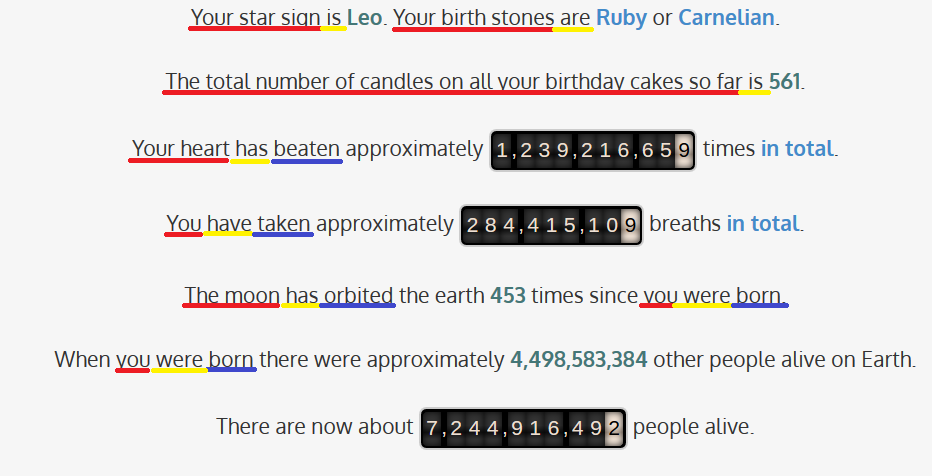
In this case I am putting in what many people believe to be Harry Potter's birthday: July 31st, 1980. After I put in the birthday and name I press go and voila! Tons of great sentences:

Check out the AMAZING variety of sentences here. We have simple present sentences, present perfect, past perfect and past passive. We have irregular verbs (i.e. is, take, beat). If your students have been taught to identify different sentences, see if they can do so now. If you are the type of teacher who prefer that students understand meaning rather than grammar make sure they notice the different way.

The website goes on. It gives you plenty of examples of the perfect tenses as well as passive (Ronald Reagan was elected President. ET was released.)

I suggest you go through the site a few times with different birthdays: celebrities, student volunteers, authors, create birthdays for characters in books you read etc.
Are you this old?

After students get the idea have them create their own "website." I am really into using things like this for literature, so I would have them do it with a character from a story we have read. If you don't read stories in class have them make it for themselves. (Note: the website will not work for people born before 1900, so you'd have to use people from the 1900s on).

The website gives examples, but if your students need prompts:
I hope you ans your students find this website as fun to play with as I do!

Saturday, July 5, 2014

Preparing for the August ELT Blog Carnival

Humor dosn't always mean acting like a clown!
The 41st ELT Blog Carnival is DONE! Check it out: http://eslcarissa.blogspot.com/2014/08/41st-elt-blog-carnival-teaching-with.html

Since my July and August are shaping up to be pretty busy, I thought I would announce the August ELT (English Language Teaching) Blog Carnival now and give bloggers plenty of time!

Are you unsure what a blog carnival is? The ELT Blog Carnival home page has examples from all of the past 40 carnivals.

The August ELT Blog Carnival will be filled with blogs about humor.

I am a teacher who strongly believes that humor makes classrooms better! This Blog Carnival is designed to let other teachers share how they use humor in the class, so that other teachers may be inspired from them!

How to participate?

There are three big ways you can participate!
  • Submit your post
    • If you have an amazing older post that you have written on humor in the ELT field (EFL, ESL, ESP, EAP, etc.) send it my way.
    • Alternatively, if you feel inspired, you can write up a new post. There are SO MANY different aspects of humor you can touch on. If you are stuck, look at these questions for inspiration: 
    • Many students find mustaches amusing
      • Do you have a lesson that revolves around a funny movie clip or a silly joke? Perfect!
      • Do you have a knock knock joke you use in class that is an example of blended speech? We'd love to see it!
      • Do you have a rewards system or class theme that is funny? Share it! 
      • Have you read a book about using humor in the classroom and you want to review it? Awesome!
      • Is there a website with funny quotes you use in class? Review it!
      • Is there a tech tool you use that makes your students laugh? Explain it!
      • How much humor is OK or When is humor not appropriate? Discuss it!
      • Do you have a story about a time humor really brought a student out of his/her shell? We'd LOVE to hear it.
      • As you can see there are TONS of opportunities! Simply find the topic that calls out to you!
    • If you feel inspired to write but you don't have a blog, contact me! I would be pleased to host you as a guest blogger. 
  • Share this post so others can get involved! (You can share this via Twitter, Pinterest, Facebook, LinkedIn, family board game night, your Nobel Prize acceptance speech, or anywhere else you think you could reach people who are interested). To make it easy for you, by clicking this link http://ctt.ec/qT9Oa you will tweet, "Im ready for the August #eltBlogCarnival on humor http://eslcarissa.blogspot.mx/2014/07/preparing-for-august-elt-blog-carnival.html Pls Join"
  • Come back August 6th to read all the lovely blogs! You can keep track of everything via #eltBlogCarnival on Twitter! Or just go to the Blog Carnival.
Funny mug! (If you can't read it the text is here)
To submit your blog you have three options:
1. Tweet it to Carissa Peck (@eslcarissa)
2. Use the general ELT Blog Carnival submission form.
3. Leave your link in the comments of this post

Please try to get all submissions in by Saturday, August 2nd!

For those of you who don't want to participate, but are eager to see the results check back on Wednesday August 6th! You can also leave a comment here and I'll be sure to remind you when August rolls around.

If you have any questions or have a request for a specific blog leave it as a comment!

Friday, July 4, 2014

Making a Kahoot


Hopefully you've already read the blog about why I like Kahoot in my class and how I do it. This post will show you how to find and create Kahoots to use with your class.

There are two options to using Kahoot in your class. You can make your own quiz, or you can find one in the public collection. First off you can go to the main Kahoot site. You can use public Kahoots without registering if given the direct link, but I am still going to say that your first step should be to register so you can search and create your own. It is fast and easy. They ask for your school, a username, e-mail and password. In less than 30 seconds you'll have your very own account.


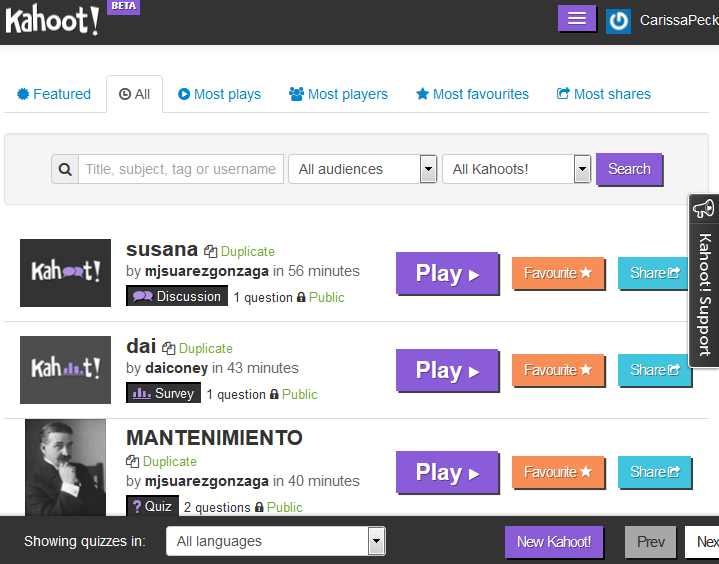
Next, if you are short on time, or you want inspiration, you can go to the public Kahoots. These have been created by other teachers or businesses. You can search these by grammar or other topic. They have Kahoots on different historical movements, different novels, and of course, different grammar points.


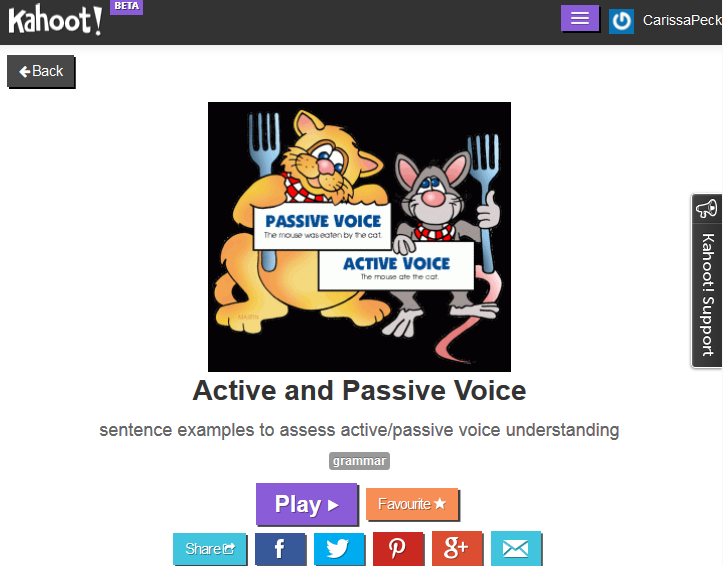
To the right is an example of a "Passive and Active Voice" quiz. You can see how many questions are in the quiz, how many players have played the quiz and preview the questions (as well as answers).

If you like the quiz as is you are welcome to simply use it. If you like some of the questions, but not others, or otherwise feel that you would like to change the quiz you can make a duplicate and then edit it to best fit your class.


The other option is to create a Kahoot from scratch. This is pretty fast as well, but can take a bit longer. First you give the quiz a name.

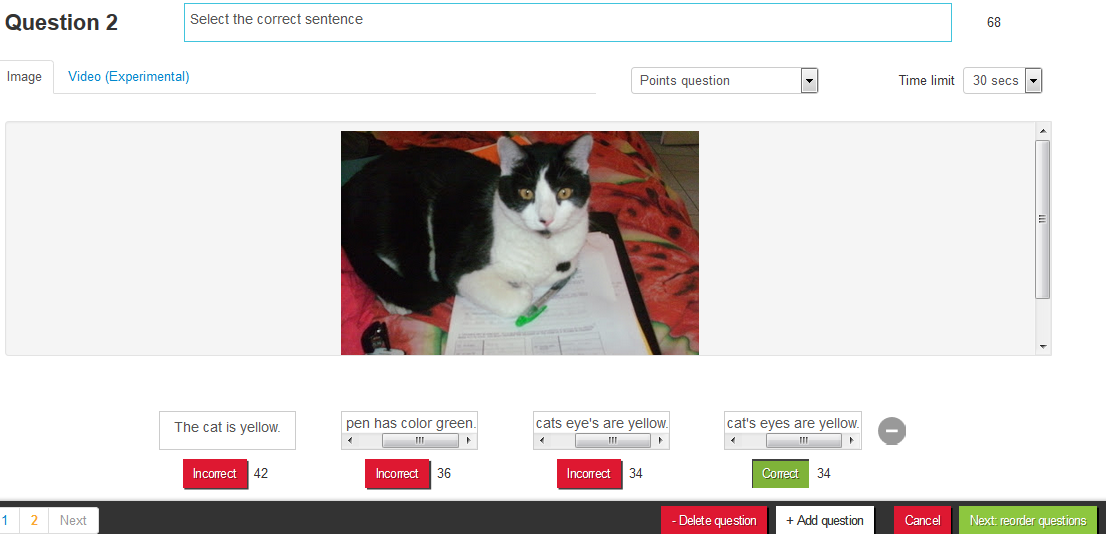
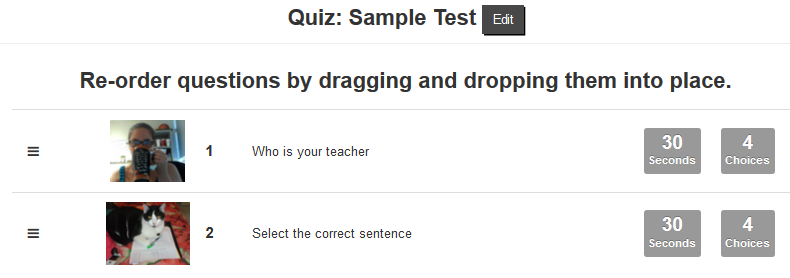
Then you add questions. Kahoot encourages you to have pictures that go with the questions, but this isn't needed. This is just a really fast quiz as an example, so I made it with two questions. You can select as many correct answers as you like. For example:


Question: Select all the adjectives in the sentence: The girls beautiful blue dress never wrinkles. 
Answers: Beautiful   Blue   Never   Wrinkles

You can give different time limitations for the questions. A simple multiple choice may be 15 seconds whereas something where students need to read larger sentences may be a minute.

After putting in all of your questions you will be taken to a page to reorder the questions and confirm that you didn't make any silly typos in the questions. If you find any typos, you can always go back and edit your questions.


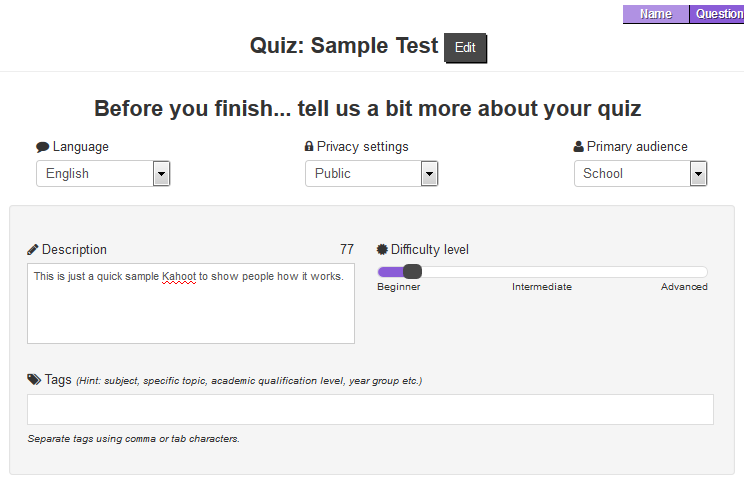
 You're almost done! Now you give a description of your quiz. Give a level, description, whom it is for, difficulty level, and any tags to help categorize your quiz. If you opt to make your quiz public it means other teachers can use it too! All of these are optional, but the more you fill out the easier it is for other teachers to find it later.

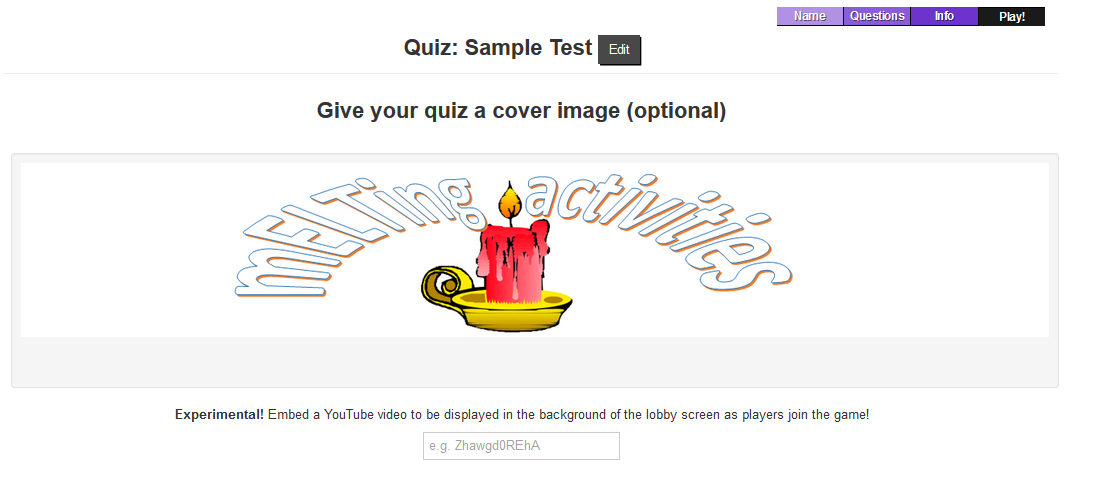
Last, but not least, you are allowed to add a cover image that will be shown while people are waiting for your Kahoot to start!
So there we go! You have a couple different ways to use Kahoot in your class.

If you make a great Kahoot you'd like to share you can copy and paste the link below for other people to see.

Here's a link to the super fast two question sample quiz.

For more on how to use Kahoot be sure to check out my other post.

Friday, June 20, 2014

Mad Gab (A perfect game for pronunciation practice)

Have you ever seen a game and thought, "This was MADE for my classroom." If you teach pronunciation in your classroom this game is PERFECT for you!

What's the premise of the game?

1. The game is basically a collection of 1,200 "puzzles" that you try to get your teammates to guess.
2. One person will read the puzzle. For example, "Bail heed ant sir."
3. Their teammates will try to figure out what is really being said.

This is a GREAT game for all the different types of blended speech. When we say, "Bail heed ant sir" we usually end up saying something like, "Bellee dants ir" which sounds an awful lot like, "Belly Dancer!"

Here's a commercial with another example:


The goal is to solve three puzzles before time runs out! With my students we normally play a simpler version where they get 1 minute. In that minute they have to try to guess as many as they can. Then it is the next team's turn.

Now, there is a website  where you can access similar puzzles for free; however, I think buying the game is worth it because it comes with this handy card holdy flippy thing (I know that's an awful description), and I think that students realizing they are playing a real game (not just one designed for English language learners) is helpful to their self esteem.

If you read the actual directions (and I always do) they include the role of the coach. I encourage this! The coach knows the answer and tries to guide the guessers by giving them pronunciation advice such as, "Put more emphasis on the first syllable," or "Speak faster!" The coach needs to be at a high-ish English level, so the teacher is an easy fit. However, many students can do it as well.

Now, I think buying the full size game is worth it; however, if the price is too high (normally over $20), you have other options. They also have a travel version for UNDER $5! It is only 240 puzzles, but a great start for your class.

I'll end with this older Tweet from Mattel
What do you think, "Nosed Ring Sat Hatched" is really trying to say? Post in the comments and I'll let you know if you are right!

Sunday, June 8, 2014

Some Sample Pre-Reading Questions

I've written about using simulations in the class to help students open their schemata, I've also talked about why this is important (if you missed that you can read more at this blog post). Just like you should stretch before you sprint, warming up your students' brains with some pre-reading activities is key.

Many teachers suggest you do things like look at the headlines, read the first lines, etc. I agree these are great skills, but one of my favorite things to do with fiction is get my students really thinking about the topic or theme (even before we've read the short story!).

For example, with Richard Matheson's "Button Button," an obvious series of questions would be, 
1. "If you could get a million dollars by pressing a button, would you do it?" 
2. "What if by pressing the button, someone would die?"
3."What if it would be someone you didn't know?"
4. "What if you would see them die?"
5. "What if it were a gun, but you knew they were a bad person?"
etc. etc.

You could mark one wall in your classroom as yes, and another wall as no. Ask the question then give the students a bit to choose a wall. Once they have settled ask one or two students why they feel that way. Then ask the next question. Be sure to ask some students that switched sides, and some students who stayed at the same wall.

If you think students may be influenced by their friends you could do this silently. Use the Socratic app, or have students put their head down and answer via raising their hands. 


Before asking the previous (more focused) questions some fun discussion questions would be:

1. What would you do for $50,000? In at least 50 words write about what the most dramatic thing you would do for $50,000. (For example. Would you eat a live baby octopus? Would you wash the dishes every night for a year? Would you wear the same underwear for a month?) Be sure to explain why this would be dramatic for you and why you wouldn’t do anything more dramatic.

2. Knowing only the title (Button, Button) write a 75 word teaser (usually found on the back of a book) describing what you think the story will be about.

3. Read the following headline: “Headline about wife hiring a hit man” Without knowing anything else write a news article at least 50 words long.

You could discuss these in class or assign them as writing assignments (to give students time to formulate their answers) and then go over their answers in small groups and finally as a full class the next day.

As you can see most of these questions are about the moral dilemma presented in Richard Matheson's, Button Button"

Another interesting discussion to bring in the class is, "The Trolley Problem,"


I would suggest you play the first 39 seconds of the video and ask students what they would do. Have them answer on their own, share with a partner and finally discuss it as a class. Then listen to the next 30 seconds where people give their answers in the video and the video explains why most people answer this way. Starting at 1:06 they explain the second scenario. Listen to this and stop the video at 1:37. Ask the students what they would do? MOST students will change their minds. See if you can figure out why. Then listen to the rest of the video.

Even though the scenario is quite different than "Button Button," we can get our students' minds prepared for the moral dilemma in, "Button Button," by having them listen to this problem.

If you end up using Button Button in your classroom, you can get more writing prompts to be used during or after reading at Teachers Pay Teachers. It is a great short story to get your students thinking about morals and ethics!

When creating your own activities I would advise you 1. Figure out what you want your students to be thinking about when reading 2. Figure out what may be difficult for them to read (vocabulary, grammar, idioms, etc.) 3. Think of what they need to know to best understand the story.

That's it! Once you have thought about what you want them to know, you can figure out the best activities to do before you read. Best of luck!

Thursday, May 29, 2014

Jenga in the classroom

Everyone loves playing Jenga. If you watch the video below even cats fall victim to this addicting game! 

How can we take this fun game and make it educational?

There are several ways!

To start: I usually play Jenga with students AT LEAST in groups of two. This way they can help one another. Remember that Jenga technically can be played with unlimited players, but in order to keep students involved I suggest no more then 4 groups.


1. Make it part of a review game.
  • Divide your class into two-four teams.
  • Have students alternate coming to the front of the class
  • Ask a review question. 
  • The first student to answer the question correctly wins two point for their team
  • Then comes the Jenga... there's a few ways to do this
    • They can choose if they want to pull a block, or have the other team pull a block
    • They can pull a block, if they get the answer right then the opposition has to put the block on the top. If they got the answer wrong their team has to put the block on the top.
    • You can make it point based by assigning a point value to the blocks gets one point, but if you make the tower tumble your team loses 10 points!
    • Alternatively, you can just make it so the first team to make the tower fall loses.
2. Make it conversational
  • Put conversation questions on the Jenga blocks. 
    • You can use a label maker to do this
    • The blocks are 1.5 × 2.5 × 7.5, so you can also use labels you can print from the computer.
    • Alternatively, you can write directly on the block in sharpie (or other permanent marker). Some teachers use pencil so they can reuse the blocks later.
  • Each time a student pulls the block they need to answer the question AND ask it to someone else.
    • Depending on the level these can be easy questions (what's your favorite food) or harder questions (If you met God tomorrow what three questions would you ask and why?)
    • An alternative would be to make this similar to truth or dare. Have a "dare" on one side, and a "truth" on the other. If the student doesn't want to answer the question they can do the dare. Keep them English related! Have them mime a vocabulary word, or sing a verse of their favorite English song.
Photo by Edgarc2
3. Use it for vocabulary practice
  •  Start a story and then have a child pull the block. 
  • Using the word they pull they have to continue the story. 
  • If the tower falls they need to quickly end the story
    • While you are telling the story have the whole class write their own version using the blocks pulled. See how many different stories you get at the end!
    • This is GREAT with transition words (First, Then, After, Thus, etc.)
4.  Make it a station / center!
If you use stations   (or centers) in the classroom, I think you can easily see how this would be a great station for small groups of students.
  • If you want to be able to use one Jenga game with multiple subjects you can have each of the blocks have a number. This number can correspond to a worksheet that the students have with different questions / vocabulary words.
  • Students work together to try to answer as many questions as they can!
    •  An alternative to questions is to have them work with grammar. For example, if you were working on tag questions perhaps you would write out things like, "Do you own a car?- Negative" and students would need to change it to, "You don't own a car, do you?"
5. For pronunciation
Photo By:  jam343

  • If you notice your students are  struggling with some minimal pairs or a tricky sound have this game focus on that!
6. Treat it like science!
  • There's a great freebie on TPT using Jenga to help with inference. This idea is great to help students with expressing their opinions, and thoughts. 
    • Because I know this, I think this will happen.
    • Also great to have students practice making predictions! 
7. Alphabet Jenga
  • This isn't the most academic Jenga, but it is easy and fun. Have students randomly select a category (food, sports, countries, clothing, verbs, animals etc.).
    • I normally put them in pairs and they can help their partner.
  • When they pull a block they need to say a word in that category with their letter.
    • Letters can go in turn (A first, then B, then C, etc.)
    • Letters can be written on the block. 
      • In this case it can be fun to have the letters written on the square outside that students can see. This way they have some time to think of a word before they select it. They also need to think about location as well as which letters are easier.
  • I tend to use the game like this for fast finishers, or if I am having a game day in the class. It could be used with stations / centers for vocabulary practice.  
BONUS!
Make any of these games even more fun by using a GIANT jenga set. Simply ask parents / students for donations of empty "fridge boxes" normally filled with soda. When you get enough (27-30 boxes) you can cover them with wrapping paper, or to try to mimic the appearance of the original Jenga set use contact paper designed to look like wood! Check out LockInLoaded's Blog for a sample of the finished product. Students will love playing with a big set, and if you use any of the games listed above they'll still be learning!
 

There you go seven different ways to use Jenga in the classroom! As you can see many of these ideas could be used for math, science, social studies or any other class! A lot of these are perfect for the end of the year, so I hope you enjoy yourselves!
Related Posts Plugin for WordPress, Blogger...