Analytics

Thursday, May 1, 2014

The five best teachers

It is May! On May sixth teachers around the USA will be basking in the glory of, "Teacher's appreciation day." May 15th is also Teacher's day in Mexico. Thus, I thought that to start May off on the right foot in honor of these days, I should write a blog about the teachers I am thankful for having. I tried to really think whom I should be appreciating. From my Kindergarten diploma (which I still have pinned to my bulletin board in San Diego) to my Masters… so many teachers have helped me get where I am today. Which teachers should receive my appreciation?

When I first thought of writing this I thought the decision would be easy. However, when I sat down to write it I couldn’t lower it to one…in fact I couldn’t lower it to a top ten! So here are the five groups of teachers who have impacted me most and whom I strive to imitate day by day.

1. The type who are passionate about what they teach.
Even when I didn’t share their passion, there were the teachers who really cared about what they were teaching. And that fact that they believed that Nonverbal Communication (Professor Beach), Group Communication (Ron Lustig), or Geography (Professor Osborn) would really be used in my life motivated me in their classes. In appreciation of them I promise to share my love of languages with students and I help them convince themselves that English will help them in their future!

2. The type who don’t give up.
I struggled in math when I was younger. My sixth grade teacher (Mrs. Corcoran) gave me what seemed like hundreds of extra credit worksheets to improve my grade and help me practice. I never became a math whiz, but I did have a solid base after that. Similarly Spanish in high school didn’t come easily to me. My teacher (Mr. Naranjo) held private classes for me after class one on one or with another student until I finally stood up mid-lesson and said, “Oh! So that’s the subjunctive!” In appreciation of them I promise that no student who comes to my office for help will be turned away, and that I will always offer extra help (be it online or in person).

3. The type who let me do new things.
In 5th grade Ms. Sipe did a State project which included presenting on different states, AND puffy painting a square of fabric with our representation of the State. This was then mailed to the state’s Governor with a letter explaining I was researching Utah for a class project and we were making a quilt of the country. If he could please sign the quilt and send it back we’d appreciate it. I must have proofread that letter thousands of times! And when I got back the envelope filled with brochures about Utah’s history and my signed quilt square, I was beyond excited! In high school my English teacher Mrs. Bamberg often did different quizzes. First we would draw out summary of a chapter, then we would recreate trench warfare in the classroom. Flash forward to studying art in Spain where our teacher (Rueben) actually took us into museums to look at the real art! This wasn’t a once a semester trip, oh no. We went at least once a month. This was groundbreaking to me. I loved being taught about things while actually seeing them. In appreciation of them I promise that I will always be willing to try new things and keep using the old new things that worked (like Skype in the classroom) 
4. The type who gave me options
My freshman English teacher Mr. Fey, my sophomore English teacher Mrs. Pyle, my Political Science teacher often gave assignments as options. You can create a diorama or write a song. You can take this class for 100% and write essays, or take the class for 90% and just take tests. Whatever their reasons I loved that these classes gave me the freedom to choose activities I felt I could really succeed in (pretty much anything that didn’t include drawing) and I use this with my student now. In appreciation of them I promise to integrate options into my students' activities.

5. The type who aren’t my teachers, but I still learn from them
The teachers whose webinars I attend, whose lessons have inspired me, whose advice has made me better have made me a better teacher. This list is probably the longest and includes my parents, co-workers (e.g. Ann, Michelle, Mickey, John), classmates, (e.g. Lauren, Juliet, Mary, Chelsi) LinkedIn group members (e.g. Sylvia , David) , Twitter Teachers (e.g. Shanthi, Shelly, John, Jon, Jase) and people in my Facebook groups. All of you have made me better. Thank you! In appreciation of you I promise to always keep my eyes open to your ideas and be willing to adapt them for my classes.

Tuesday, April 29, 2014

Quick Key and Me! (Getting Set Up)

I briefly mentioned QuickKey in a past post about grading hacks. At that point it wasn't of much use to me because I didn't own an iPhone or iPad. However, for my birthday I received an iPhone! It is an older version, but it still works fine for QuickKey.

Now that I've been using it for a semester, I thought I'd write a quick post about my likes, dislikes and hopes. First off, keep in mind that this app is in Beta. That means it is constantly growing and changing!

To start: I do NOT think that every test should be multiple choice. However, I do teach TOEFL preparation and it would be irresponsible of me not to prepare them for the test format as well as the grammar. I also like using these for quick exit tickets. Simple questions that let me know what I need to reteach and what they understand.

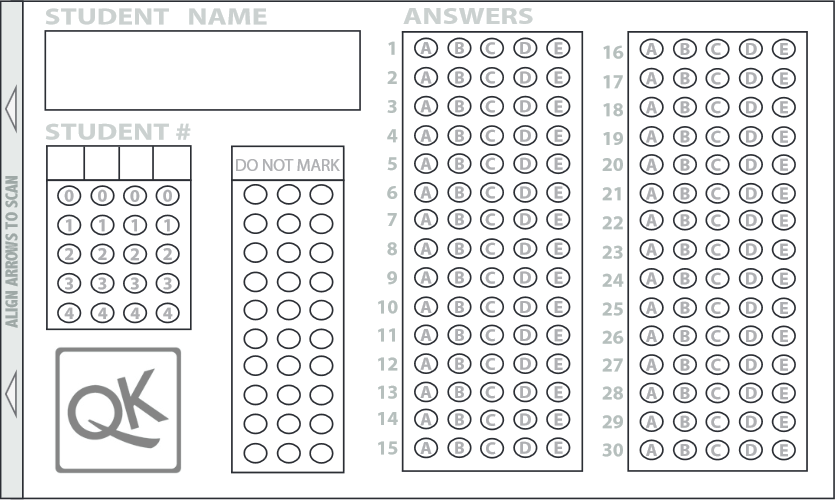
OK, so to start I make a profile with QuickKeyApp super easy! This only requires my email and a password!

Once started create a new class; just give it a name and description (optional). To add students you can download the excel template and fill it out with students' names and emails (optional).  This is probably the longest part, but if you use something like engrade, then you probably already have a list to copy and paste.

From here you make your quiz. Depending on how long your quiz is this will take you a bit.
(Problem 1) You do not NEED to fill in the questions as you will NOT be printing a quiz from this site. That's actually one of the things I don't like :(

However, I usually have my quizzes in a Word document anyways, so this isn't a huge deal. Finally you print the answer sheets so that each student has one.

(Problem 2) They say that in the future you will be able to assign students numbers, but for now they are random. This is problematic because my students kept messing up their numbers. One test I even put their last name and then their number on a piece of paper and had them fill it in when they turned in their test. I still had some students make mistakes. Now I pre-fill in the answer sheets with the student numbers. This is time consuming, but mindless, so I can do it when I am listening to music or watching a movie. Because of this it isn't worth it for me to use QuickKey unless I am really going to save lots of time with the grading.

Later I'll have another post on how to grade and some tips on grading successfully.

What are your thoughts on QuickKey? Have you used it in your classes? Questions on how to use it? Leave a comment; I'd LOVE to hear from you!

Friday, April 11, 2014

Spring has Sprung!

No ears required to be festive!

Spring has come and there are a lot of great activities you can do with your students to celebrate springtime!

1. Spring means the Easter Bunny! Even if you don't celebrate the holiday you can use this fun song to practice body parts, animals, and adjectives. Interested? Check out the sweet little bunny!

2. You can practice some prepositions, and get your students moving by dancing the to the Bunny Hop

3. Working on emotions with your students? This free printable involves a fingerplay and coloring pages with an egg theme (perfect for Easter).

4. Have your students practice using more precise words AND decorate your classroom with flowers with this Fun Flower Activity. (pictured to your left)

5. Have little ones work on the different names of plants (stem, petals, etc.) with this game / chant, "Oh No, Poor Flo."

6. Flowers mean bees! Here's a bunch of bee idioms


7. Earth day is coming up! Grab a free book with TONS of water ideas. Some resources are on conserving water, others on the water cycle. Lots to do!

Those are seven awesome activities that work well with spring. What's your favorite activity to use in the springtime?

Thursday, April 10, 2014

Simulations in the classroom

Have you ever had students bring in old items from home, issued them fake money, and let them buy items from one another? It is a great way to get students using vocabulary in a lifelike situation! You aren't role playing; rather, students are really exchanging currency for products. They can haggle, contemplate the worth of something, and budget. This is called a simulation.

Simulations are very popular in all types of educational settings because they help students see that what you are teaching them in the classroom is valid in the real world. Why are simulations so successful? Think back to when you were younger. If someone said, "The oven is hot; don't touch it" what did most children do? Touch it!

It isn't (usually) because they are trouble makers. We want to experience things fro ourselves rather than trust what someone says. The child thinks, "maybe the oven is hot to some people, but maybe I won't think it is hot," or, "well how hot is it?"

Simulations are great because they show our students that what we are talking about is real. They also let us discuss what we want to with our students knowing that they all have a shared background.


Finally, they are one of the ways I encourage teachers to help students open their schema. For example, if you were going to teach about social hierarchy you could ask a series of questions about their own experiences interacting with different classes or you could use a simulation from Shilo Morlang's book, 10 Sims for Teachers involving a deck of cards. Once they have all finished the simulation, you can discuss what it reminds them of, how they can see it in other parts of their life. This is a great way to be sure that your students are prepared to have the knew knowledge of their class, "stuck" in their brains!

On a related note, check out this video made for teachers at my school on different ways to help students access prior knowledge.

What's your favorite simulation to use in class?

Monday, April 7, 2014

Listen while you read

One of my favorite assignments to give to students when they've finished reading a section of a book is to make a soundtrack for the book or chapters.

I love the reasons my students give me for selecting a song. The lyrics may remind them of the character's emotions. Other times the melody reminds them of an event (e.g. it sounds like waves to them and the scene is during a storm). Other times it is just the ambiance that it adds.

Here's an example of the assignment:


I love the assignment because I get to discover new songs, and get an idea of what type of music my students listen to in their free time. I also find that students have to really understand a chapter to pick music for it, which helps their critical thinking skills.

Some students are more comfortable with pen and paper, and others prefer actually making a YouTube Playlist. However, recently I've discovered an online tool called Booktrack! There are a lot of different ways to use Booktrack!


One way, which doesn't require much from students, is to add sounds to what they will be reading at home. This helps students get in the mood, and helps them get sucked into the reading!

Check out the infographic on the right to see what one study done by the University of Auckland showed! To read more about the studies done check out their site! Basically, they will understand more AND enjoy it more wen they are reading and listening.

In the future I plan on assigning each of my students a different book to read at home. I feel that having them summarize what they've read and add sounds for mood to their summary would be a GREAT assignment.

If you're working with public domain stories (Shakespeare, Grimm Fairy Tales, etc.), you can divide the class so that each student has a different chapter. Have them individually make a booktrack and then assemble is together for a reading experience future classes can enjoy!

Saturday, April 5, 2014

What's the buzz, and other bee idioms

As I promised in the last post, here's a post about different bee idioms. At the bottom you can see handouts you can use in your class!

1. What's the buzz?- What's new? 

Why? When people are in a room talking quietly it can sound like buzzing. "What's the buzz on your new student?"

2. Buzz with (something)-Be excited about (_)

 Why? As with above, the sound of many people sounds like buzzing, so these terms are very similar.  "The teacher's lounge buzzed with strangers only present for the conference at lunch."

3. Make a beeline for / to- To head straight for something

Why? Before we understood the science of the bee's waggle dance people noticed that bees tended to leave their hive and go straight for the source of nectar (usually flowers) , that is, 'make a beeline' for it.  "When I get to school, I make a beeline for my laptop."

4. Like Bees to honey- to be attracted to something


Why? Since bees are normally where honey is, people assumed that they must be attracted to it. Hence, "Women are attracted to him like bees to honey"

5. Buzz off- Go away!

Why? When you want a bee to leave you alone you can have it, "buzz somewhere else." Hence you ask it to buzz off. The same applies to people, cats and dogs :) "I've told you a million times; I won't date you because you're marries. Now buzz off!" NOTE: This is pretty rude.


6. Hive of activity- Very busy!

Why? Have you ever looked inside a hive? It is normally swarming with bees all very purposefully working. Hence, when a place is busy it becomes a hive of activity. "Normally the airport is quite empty, but Friday nights it turns into a hive of activity."

7. None of your beeswax- None of your business.


Why? This is a juvenile play on words because business and beeswax sound similar. I wouldn't suggest using it in an official setting, unless you're making a pun. "Stop asking me for your friend's grade! I told you it's none of your beeswax."
NOTE: Also MYOB: Mind Your Own Beeswax :)

8. Bee in his bonnet- To be very focused on one idea

Why? Imagine that you were wearing a bonnet like the one pictured on the left. Suddenly a bee flies into your bonnet. Would you be thinking of anything other than the bee?  "First time blog readers must think I have a bee in my bonnet about Springtime"

9. The birds and the bees

Why? This is what we say as a euphemism for birth (including sex). It become this as many parents would try to explain birth by using an example that didn't require mentioning intercourse, hence: the birds and the bees. "If I am not ready to explain the birds and the bees to a child, then I am probably not ready to have a child."

10. The bees knees- Awesome / Amazing

Why? This is a fun one! When I was younger I was taught it was 1920's slang for business. As in something was good business so it was the bee's knees. Others have suggested the bee's knee is where pollen is kept hence making that a great spot! In truth we may never know, but it is still fun to say :) "The new coffee place is the bee's knees" Note: Officially (in dictionaries) I see this bee's knees. I've also seen it bees' knees. In most newspapers it is bees knees. I am not sure there is a solid punctuation rule.

So there you are TEN idioms related to bees. There's one I left off just because I felt it was too easy :P If you think you know it you can leave it in the comments!

Following is a worksheet of five pages. Two are designed for children, two for older learners and the final activity page can be used with anyone.


Friday, April 4, 2014

Help the Bees, Grow the Rainbow

Springtime is here! I've already blogged about how to have your students review the parts of a flower, and about how to help them make vocabulary gardens to decorate your class.  I am partially inspired by the season, but also by the month!
April is home to Earth day and the 22nd is fast approaching. Have you taken any time to address ways we should care about Earth for Earth day? There are so many aspects to cover. We can talk about recycling, water conservation, avoiding plastic, and so much more. However, in many cases, our students hear these things over and over, how do we introduce them to something new?

Here's an easy way There are some great news articles out there on the issue with bees. BreakingNewsEnglish has a lesson set up to go with an article about the disappearing bees.

Who cares about bees? Well, we all should! It is well documented that bees pollinate about 33% of our food! Disappearing bees means our food is disappearing as well. What kind of food is impacted? Berries, burgers, beer, and coffee are all on the hit list. If the idea of not having coffee isn't scary, then know that they also affect about $15 billion worth of US crops!

How to incorporate this into your class?


If you teach younger students Pollinator has some great activities! I think the vocabulary is too intense for most younger EFL students, but you could adjust them pretty easily. Plus their snacks look delicious!

I would use the snacks to talk about the importance of bees. Then, I would see if I could get us permission to plant seedles in our school. There's lots of grammar to be practiced! Practice comparatives and superlatives by seeing who can throw is the highest, or closest. Practice prepositions: over the slide, beside the fence, etc. See if you can practice numbers and colors!


Seedles are PERFECT for the classroom as they are completely non-toxic. This means they are 100% safe to touch! Basically, your students can play with them without you stressing about them being exposed to chemicals. This year, instead of worrying about how to celebrate Easter without leaving out the non-religious children, celebrate spring and making the world a better place by throwing seedles around!

If you can't afford to support their project by buying the seedles, you can go to their kickstarter page. There they give you the recipe to make your own seedballs. You could make them as a class, but then I think you would need a LOT of  parents helping.

Now if you're thinking, "Wow this is a great project, but I am the lesson seems way too easy for my students." That's fine. I have another idea for you :) Right now I teach Business English, so I would probably do the following:

Step 1: Read an article about Seedles.

Step 2: Discuss the goals, and the market.

Step 3. Design a marketing campaign to help Seedle meet their goal. Could we approach larger food companies with hopes of helping save their reputation? Meet with local farmers about helping their crop? How would they use social media? etc.

Step 4. Watch the video

Step 5. Discuss the video. What market did they try to reach. Would you support them? Why or why not?

Step 6. Come up with your OWN solution to a problem plaguing the Earth and pitch it to the class! 

If you don't think this lesson plan would work for you, that's fine! In fact, you can join the "Grow the Rainbow Campaign" and sign up as a classroom champion. If the kickstarter goes through you will receive a PERSONALIZED curriculum for your class!
  • If you are teaching university students about Thoreau and sustainability, I am sure they can find a way to work with that. 
  • If you want to look at the business aspect, they can help you with their experiences! 
  • If you teach little ones they have some  art and theater based ideas where everyone would play a part in a classroom reenactment of pollination. Of course they would also get some new vocabulary!
  • If you teach high school students, you will receive a task based physical science lesson.
Ei Ei, one of the people heading the Kickstarter, used to manage an environmental education program in the San Francisco public schools, so she is well experienced in tailoring environmental curriculum to be integrated into your classroom. This way you can be sure that the lesson is designed for your class, rather than receiving cookie cutter lesson you have to adjust to fit your class.

Can't wait to start talking about bees with your class? Tomorrow I'll be posting about different figures of speech with bees. In the meantime I'd encourage you to help grow a rainbow! Even if it is just by liking their FaceBook page.

Wednesday, April 2, 2014

Children's Book Day 2014

Because of Hans Christian Andersen (or at least it is usually around his birthday) once a year on April 2nd we celebrate children's books! To celebrate here are a few of the children's eBooks I have read within the last 12 months that I really enjoyed, and maybe you would too! They are all available as eBooks so those of you


I just wrote about one children's book I love called Am I small? In this story a girl asks for the opinions of others to find out if she really is small. I great vocabulary builder and available in multiple languages. Plus I have made a few activities that fit nicely with the theme! You can encourage students to use a larger vocabulary, realize small words have multiple meanings or make pretty decorations for your class.


Much Ado About Puffins is a beautifully illustrated book about the trendsetting Puffins and one Puffin named Gertrude who just never quite gets with the trends. It sends a nice message about not worrying about staying trendy and instead staying true to yourself! It could also be tied into recycling and trash quite easily (as the puffins collect the garbage that is washed in from the ocean). Plus, if you visit his website and join his fan club you can receive a free Personalized eBook! Seems like a great gift to yourself for international children's book day!


I'll Follow the Moon is a cute story that is really about the connection babies and mothers have. While some of the words are more advanced there are a LOT of action words. That means you can have students act out the story as you read it! There is a verse that is repeated throughout the story so students can quickly grasp onto that and "read" along with you. Even though it isn't scientifically accurate, it is a very cute feel good story. Plus, it may inspire your students to learn more about turtles in life.
  

Splodge Gets Lost in London is a great model to use for class. It is an eBook that is set up similar to a comic book, and this story is set in London! Great if you are trying to teach your students about life in England as it shows lots of famous landmarks. I think it would be great to have students make their own versions with their animal getting lost in certain parts of their city.

The Knot Monster is another great one with a teaching moment! In this story a girl is introduced to the knot monster that messes her hair up every night. I am not thrilled with the ending, but I think that bad endings make for great class activities. Discuss what better solutions would have been. Maybe draw and write your own ending to the story.

Finally I really enjoyed, "Little Monsters have feelings too!" The book essentially asks children what they would do to monsters? Would they treat them poorly or treat them well? It is well written, simple, and colorful!Most importantly! It really sends a positive message about not bullying and treating others the way you want to be treated.

There you are! In honor of children's book day those are six books I think would go great in a classroom.

Tuesday, April 1, 2014

Oh No Poor Flo!

Spring is here! Well, for those on this part of the world it is. In honor of this season I have made a quick PowerPoint / activity about Flo! This reviews the parts of a plant for beginning students using a flower named Flo.
If you want to practice more skills you can have your students practice introducing themselves to Flo and asking how she is. 


It is VERY similar to other activities better suited to other seasons such as the winter Oh no Poor Snow and the original Oh No Poor Joe. In addition to the Powerpoint the last two slides are worksheets you can print for the students to complete on their own.

If you prefer to use YouTube here's a recording of me reading the PowerPoint (it is also included at the end of the SlideShare presentation)

2014 ITESM Dream Flag Video

The Dream Flag Celebration is this weekend!

My students and I aren't able to join (the 2,000 miles is a bit much for us), but we were able to send a video which will be shared during the celebration. Check it out!


The director of the dream flag project, Jeff Harlan, was kind enough to send us a thank you "Got the video. Awesome! We'll show it Saturday. Please tell your students that we really appreciate their effort. More than 500 people will attend Saturday and be inspired by your dreams, your energy, and your great work."

To look at all the other Dream Flags created this year by ITESM students you can go to the dream flag gallery.


Monday, March 31, 2014

Cut a worksheet for a change of pace!

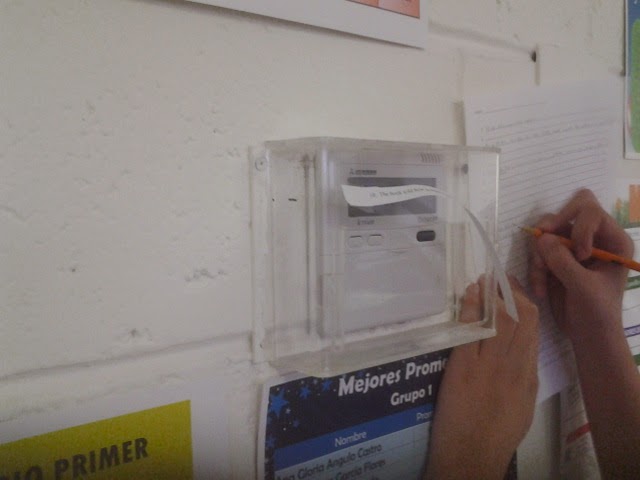
What is my student doing at the window? Admiring the view? Taking a break? Trying to get warm by leaning against the window heated by the sun? Actually he's working on a worksheet!

There are a lot of people who feel that worksheets for the most part are no longer needed in class. It is an interesting and environmental idea, but sometimes I just like having my students use worksheets.

However, I do think worksheets can become a crutch. Like PowerPoint, webquests or any classroom tool, if we use it the same way too much, it doesn't provide the variety our students need.

This blog is not about a brand new technique. I think teachers were doing this back when I was in elementary school! However, it is an easy technique to use a worksheet in class, but vary the format a little. Students tend to like the fact that get to move, and I like the fact that they are getting work done.

Step 1. Select the right type of worksheet. In this case I used a "correcting" worksheet. It had 25 different sentences that were not parallel. The students needed to re-write the sentence to make the sentence parallel. If also you teach parallelism in writing here are 15 sentences your students could fix.

Step 2. Cut the worksheet up into strips (with each question / sentence being a different strip).

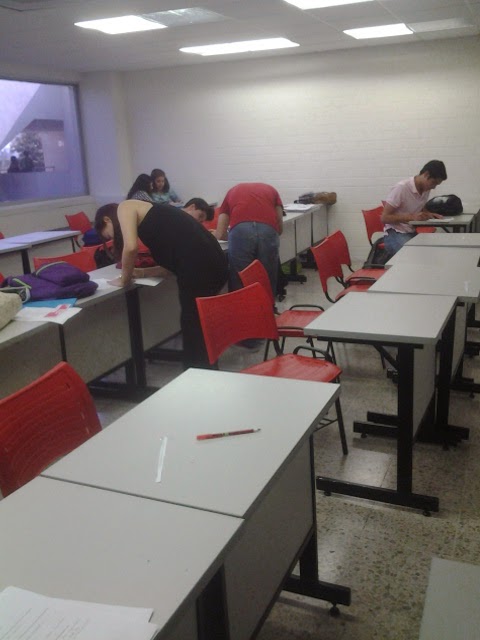
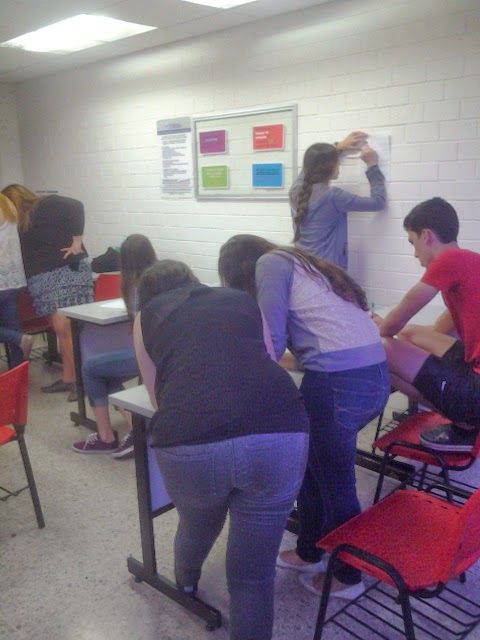
Step 3.  Tape the strips everywhere around the classroom.... I mean everywhere! On desks, on windows, on walls. With little ones putting them under tables and chairs is fun, but my high schoolers care too much about their clothes to crawl under a chair. If you write in a really big font you can tape it to the ceiling and have them look up find that sentence.

Step 4. Give the students a set amount of time (I gave 20 minutes for 25 questions) to walk around the class and try to fix as many sentences as they can. Encourage them to work with a partner as long as they keep the communication in English.

Step 5. Give a final 5 minutes to compare their answers with another person / pair.

Step 6. As a class go through the answers. If they can't fix a sentence try to lead them towards the answer, but don't give it to them. If they still can't find it skip it and go to the next sentence. Sometimes they just need time away from the sentence to see the mistake. Normally they figure out all of the sentences, but when they don't I prefer to assign the ones they don't have as homework rather than to give them the answers.

Things to keep in mind
Control: You need to make sure the groups are controlled. If they start aren't actively working give them a warning and then have them sit down on their own with the worksheet.
Type of worksheet: Make the answers easy(ish) to write. You don't want to do this if each answer requires a two paragraph answer. On the other hand, just having them write down A or B doesn't get much writing practice in (nor does it help them study later)! Short answers are your best bet.
Time: Set a time limit and stick to it Some students are faster than others, that's fine. I like to give way too many problems. For example I may give 25, but I think getting 20 done is good. IN the last minute I encourage students to check with other groups and finally go over it as a class. This way even if they didn't get to all of them they have the answers in the end and there (usually) aren't fast finishers.

Like I said, nothing new, but always fun! Enjoy :)

Thursday, March 27, 2014

Gradients of meaning

Here's another activity linked to Am I Small?

If you have your own classroom here's a fun bulletin board project! Give each student a a paint strip (you can get them for free from your local hardware store: Home Depot, Lowes, etc.) Paint strips have recently gained popularity in crafting and are no longer used as samples. As a result some stores are charging. Rather than take the samples from the paint display, ask the manager if they have any expiring paints that you could grab the sample sticks for when they expire. Or, if they have any expired paint samples ready to toss. 

Once you found your paint strips, write a "boring" adjective on the bottom (the lightest color) then have them choose their own adjectives that mean the same (or similar) but are more powerful. Have them write these on the darker parts. What do I mean by a boring adjective? This post talks about it in more detail.

You can use the story as an example and make a couple sample paint strips using the words from the story.

When your students finish these make great Spring decorations for a bulletin board, door, or wherever you like! You can put a title on it like: "Keep your language colorful" or "Make the world a more colorful place!" and then fill the board with your students paint strips! 

Here are four different "Rich" cards showing different denotations.
Another option is to explore different meanings of the words. Let's look at the word rich. 

Ask what the word means, then give them different examples.

Or, you can get your students to figure out what the different meanings of rich are. It can mean to be well off, to have a lot of something, have a lot of intensity, to be buttery and thick (with foods), to show irony, to be interesting, to be prolific, etc. Once you have the idea see if you can give them some other words.

Divide the class into small groups and give them each the same word. However, tell them to each focus on a different meaning of the word. To get a good idea of words with different meanings you can check out the two part list here. If the groups are bigger then have two students work on the same denotation, but try to come up with different words.

On the bulletin board make brown or yellow circles that contain the "boring" words. Surround these circles with the finished paint strips so the yellow becomes the center of the flower and the paint strips are the petals.

Let your students know that this is their Synonym Garden! Whenever they want inspiration on better words to use, they can look at the different meanings words have and pick a more specific description.


While I think this project words wonderfully with adjectives you can do it with nouns or verbs too! For example, the word run has many different meanings (you can run a computer program, run for office, run a company, etc.) If we were talking about moving quickly: run-speed-hurry-hasten-zoom-bolt.


I don't currently have my own classroom :( So, I am not able to show you how pretty it looks.

If you manage to do this with your class, I would LOVE to see the final product!
Related Posts Plugin for WordPress, Blogger...