Analytics

Thursday, June 4, 2015

Using Small Words to Define Big Ideas

I am an xkcd fan! I am not nerdy enough to be good at math and science, but I am a language nerd which means I still enjoy all things nerdy.

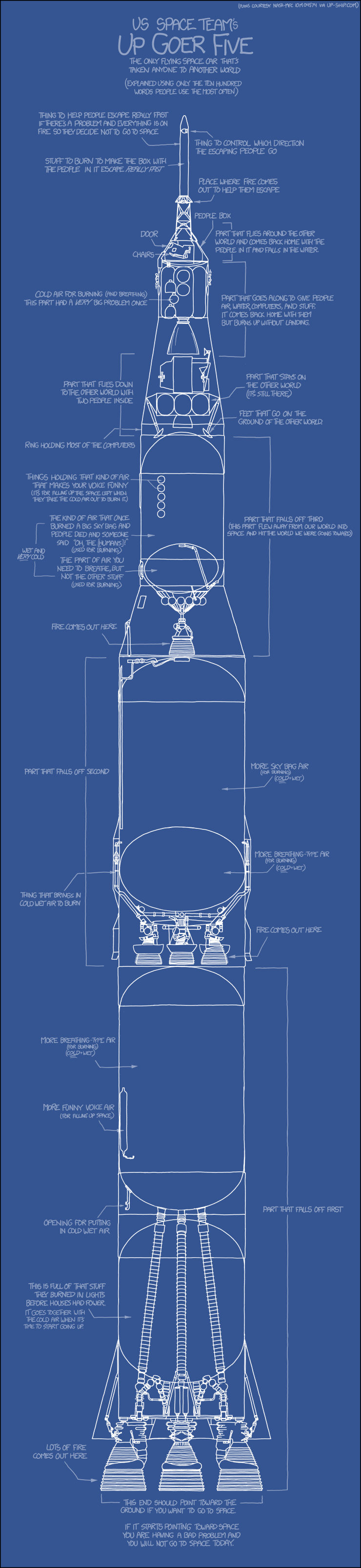
I recently discovered he wrote a book called the Thing Explainer: Complicated Stuff in Simple Words. The concept is similar to simple wiki, which explains things using a non-technical vocabulary. Although, unlike simple wiki he limited himself  to only using the 1,000 most common words and his drawings of course..

Thus, datacenters are referred to as computer buildings, tectonic plates becomes the flat rocks we live on, airliner cockpit controls are the things you use to steer a plane, and cells are referred to as the little bags of water you're made of.

You can see an example of this concept to the right with a plan of the Saturn V being described using only the most common, "ten hundred" words.

What's the connection?
How is this related to English class?  Here's my theory. Students are often overwhelmed by the vocabulary as much as the size of a text. So, why not, on occasion, have them really break it down.

Yes, knowing the literary terms: protagonist, foil, and hyperbole are important, but do they really know what they mean or are they regurgitating vocabulary you've covered.

You could do this with any vocabulary, but since I am in the midst of planning for next year literary terms springs to my mind. If you aren't on Summer break right now, maybe you would want to do this a review before the end of the semester exams come around.

How
1. Have students come up with a list of words they learned last year, or give them a list of words they should know.

2. Pass out a list of the top 1,000 words in English
  • If you are a tech savvy class you can send them to the link you want to use. I like wiktionary, but there are many others.
3. Have students define the assigned words using ONLY the tip 1,000 words.
  • I would probably do think pair share or pyramids here. 
    • Students start on their own, then share with a partner, then two groups of partners get together) etc.
4. Finally ask for volunteers and see how well their definitions fit? Did they define a protagonist as a good guy? Is that really accurate?

Use the Short Answer function for students to submit and vote for definitions
5. Collect the definitions of the words and on Socrative, postits, etc. have students consider which definitions they like best.

6. Make a "literary terms" dictionary (in the spirit of the assignment call it a "Book about Book Words." Keep it in the class library, or save it and have it available online. Either way students will now be able to consult and know the words you plan on using in class.


Why?
I like the concept of this activity for several reasons, but here are the big ones:

It uses critical thinking. Maybe they want to say dramatic irony is when "the audience knows something the characters don't" Audience isn't a word, so they need to think of how else they would describe them, "People who listen or read know things the people in the book don't know." Since I teach the ELL students this is also a great example of circumlocution.Which is the process we go through when we need to talk around a word.

I am sure you do this a lot with movie stars or book titles. You are talking to your friends about a great old movie you saw the other day and you can't remember the name. You don't just stop talking, you describe it, "It has that actress we both like from Gilmore Girls, but not Patty...and she falls in love with the guy from that Trident commercial who looks like your cousin." etc.

When students learn they can describe almost anything using these words, they should have more confidence writing and speaking in class. Plus, it gives you a chance to confirm if they do in fact understand the vocabulary.

What do you think? I'd imagine you spend most of your class time getting students to use bigger words, would you ever do an activity like this that used smaller words?

Thursday, May 28, 2015

Alternative to Vemn Diagrams

Anyone who watches Dr. Who knows that bow ties are cool.

Well, here's a way to bring bow ties into your graphic organizers! Why you may ask?

Maybe you're perfectly content with Venn diagrams. That's awesome! I never was. I always felt they were very awkward and didn't give me enough space to express myself.

Check out this video for more on my hatred, and alternatives to the standard Venn Diagram, including the Venn Bow Tie... because Bow Ties are cool.


For anyone wondering why I am comparing Mean Girls and Julius Caesar, check out this post where my stduents make infographics exploring the similarities and differences between the movie and the play.

As promised in the YouTube description, if you go to Teachers Pay Teachers you can download a free worksheet with some sample pages. Try them out, and let me know what you think.

Most importantly, if you have other graphic organizers that you love, or if your students like the Venn Bow Tie, let me know :)

Wednesday, May 27, 2015

Speed Dating

Here are my students during their most recent speed dating class

Speed dating is not a new trick for teachers. I used to use it a lot for class warm ups or bell ringers. The assignment varies a bit, but essentially, students talk and listen to a partner for a set period of time, then they switch partners and repeat.

Types of Assignments
This works well for grammar or vocabulary practice. These can be the same story thing and over, or you can give each partner a card with a different question. For example, I could have each students give a mini biography of themselves to practice  simple past tense: I grew up in San Diego, I went to Santa Sophia Academy, etc. Or, I could have each student have a question that they ask their partner. Some may ask about family, others about travels, etc.

In the picture above my Speech students are working on practicing their historical speeches (students were each given a speech to memorize and present to the class) Since they didn't need to write a speech, they could focus on tone, gestures, volume, etc This was a great way to have a lot of them practice to new listeners rather than listen to the same speech over and over.

Pros

It is different! Some students may get nervous when they see the new seats (even if they knew it was coming), but in the end something new is good for their neurons and their interest in the class.

It is rather hands off. As a teacher I can walk around and watch almost all of the students. They require very little interaction from me.

It is fast paced. Students don't get bored. They are always on the move.

Cons
For the most part this can be adapted to any number, but on occasion I have an assignment where I need it to work with an even number. In this case, I put a desk in the middle and have a student practice on their own, or work on a reflection. In one case I used it as a chance to have quick mini-conferences with that student.

It doesn't lend itself to an "in-n-out" class. By that I mean, if you have students who are coming in late, or being pulled out in the middle of your class it really messes up the flow of class. Try to keep this for a day that you think things will run pretty smoothly.

Tips and Tricks
Have fun with it! Before starting have students sit in front of the class and play "charades." Have them pick dating faux pas like texting on a date, talking over your date, falling asleep on your date, not making eye contact, etc. Include some positive things as well: leaning forward, smiling, nodding your head, etc. Students will love watching one another ham it up in front of the class, and you'll be able to have good behaviors modeled and encouraged.

Give the listener a reason to listen. Either let them know that they will be telling about what they hear, they will be tested on it, or they will need to evaluate their partners. Something to keep them accountable. Real speed dates usually end with people turning in requests for dates, so why not have your students turn in whether or not they'd want to hear the speech again with a quick reason why.

I set up the tables before the students arrive. I put two different colors of tape on the board with numbers with a note to grab a number and sit in the matching seat. This isn't really needed but I find, "inner circle" and "outer circle" confuse the students, but if I say, "read tape" and "blue tape," then they all get it immediately.

Keep everyone moving! Normally in speed dating one group of people (e.g. ladies) will stay seated the whole time while others will rotate around them. My students are all equally antsy. To keep people seeing different partners, I alternate rotations Those on the inside of the circle rotate to counterclockwise one time, and the next time the outer circle moves clockwise.

Concluding Remarks
This is a great highly active way to practice...and we know so much of language and speaking is "Practice, Practice Practice"  
A photo posted by carissa (@clarissasinel) on


Does anyone else use speed dating in their class? Do you have any other suggestions, tips or tricks? Comment below or let me know on Twitter or Facebook.

Saturday, May 23, 2015

"Shirt Day" Project - Persuasive Skills Project

This year I have worn:
Red to raise awareness about heart disease in women. Pink to fight bullying. Jeans to support our troops
AND MORE

It got me thinking, with all these great days and colors, how could I make this into an activity my students would learn from and get them involved outside of my classroom!

And thus was born the "___________ Shirt Day" Project


I used this for my speech class since students were really struggling with audience. In this project they have to consider three different types of audience, which is perfect.

The Basics: 
  • To introduce the project I find out what day is being celebrated that they may not know about. This sparks their interest and lets them see a model of me showing them how to persuade.
  • Individually, students picked a "day" that they felt the school should honor. They give a speech presenting the day and persuading the class to vote for their day. 
  • The class votes and the top two "days" are the winners.
  • In small groups the students make persuasive video convincing the school administrators to let the school celebrate one of the two days we voted as leaders.
    • Students vote on the best videos
    • For the grand finale: The administrators watch the winning videos and select which days they want to support.
In More Details:
This was a really great project to have students practice different approaches and audience.

The speech they presented to class focused on different ideas than the video they make later to convince administrators to let them celebrate.

Motivation:
This was a great project because it was REAL. Students knew that their videos would really be watched and that everyone in the school would have the opportunity to "win" because of their convincing videos. Now, part of this motivation came because I work at a private school and my students normally wear uniforms. Nonetheless I think most students would find it awesome if the school did something because of a presentation that they made.

This year I whipped it up last minute, so the worksheets and directions aren't perfect. I'll replicate it next year and give you links of where to get copies.

Friday, May 22, 2015

No-Prep Alphabet Review Game

For me it is finals week!

I really do think that teacher made reviews are the best. After all, we know what will be on the test :) However, there is something to be said for student made reviews.

First, it gives me, aka the teacher, a chance to see what students feel are the most important parts.

Second, I can find misunderstandings and quickly clarify on the spot.

Third, any time students are creating something, I feel that they learn more.

Finally, if at all possible, I like to steal questions or ideas from them to put on the tests. This way the activity feels more "real" and the students can see I do listen to them. This isn't always necessary as quite often students will hit the nail on the head and ask questions that are very similar to what the test had originally.

Here's one of my favorites because it is so easy and adaptable.

ABC
This year I didn't have a chance to make my alphabet books (next year I will). However, I did use this super easy review game with an alphabet theme.

I divided the class into three different groups based on what we had studied. This was a literature class so: "The Rubaiyat", Magical Realism, and Things Fall Apart. In their groups they received different worksheets with letters of the alphabet and made review questions based off of those letters.

This could be done without the worksheets making it completely no-prep. Want more details? Read on:

  1. Depending on how much information you covered make those different groups. These can be very basic, or more complex. In many cases it will be the different units you covered.
  2. I like to start individually, and then have students pair up, but if you want collaboration right away then assign pairs different chunks. 
    • Assign each student a different chunk of the alphabet and a topic. You can have this on the board, or just verbally. Since I have them pair up later each chunk should be assigned more than once. 
      • One student may be given A-H - Things Fall Apart, and other student A-H- Magical Realism, while another I-P Things Fall Apart etc. 
      • I give the last group (Q-Z) more letters because they are harder, and will be able to skip more in later steps.
  3. Give students just over a minute per question. Students must create a question where the question OR answer uses the letter. 
    • A- What's the word that means really dry? Arid OR Angels in "The Very Old Man With Enormous Wings" are thought to look like what?
  4. If students haven't finished that's fine as long as they have started. If you feel most students don't have many questions yet, then give them more time before pairing up. Now they get to brainstorm! Have them meet with another student who has the same assignment. With my students they usually end up in pairs, but if you have a bigger class it may be groups of three. Have them compare their questions and answers. Together they'll keep the ones they like best. This also gives them a chance to help each other if they were missing a letter. At this point, I tell them I expect them to have 7 questions. This lets A-H skip one letter, and Q-Z skip three.   
    • For example, All of the A-H Things Fall Apart students will get together, re-word questions, eliminate duplicates, and decide on the seven that they like the best.
  5. Now for the big groups. Have the whole alphabet get together! That means everyone creating the Things Fall Apart review (A-H, I-P, Q-Z) will be in the same big group. As a group they need to come up with 20 questions! There should be no duplicates. This gives them a chance to weed out the duplicates, primp the questions they have and (if they are giving the presentation verbally) decide who says what.
  6. Finally, students present these to the class, and the class tries to answer them. This can be done however you like!
    • If you have time and technology available, you can have the groups make Kahoots and then play them as a class.
  7. (optional) If you have time have the students fill out a quick exit slip. What questions were hard for them? Why? What questions were easy? Why? What information will they review because of this? 
This requires no prep and is really a great chance to have students review the material. I saw pretty much every student take out the text and their notes to try and find how they could make their letter work for the review.

Wednesday, May 20, 2015

Get your school some money! (TurnItIn & Target)

Have you heard of Target's "Thanks a Billion" campaign going on right now?

You can thank a teacher via their site and they'll donate $25 to the school!

I've read the small print and it is legit.

The program runs from Starting on May 14, to June 15, 2015 (or when Target donates a total of 6 million dollars).

No school can earn more than $25,000 total, but that's a nice chunk of change.

So, what do you have to do? Not much! Visit www.Target.com/ThanksABillion and log in using your Facebook account. Then find your K-12 school using your zip-code. Add a message and send. Voila! You've donated $25.

You can thank as many teachers as you want, but only your first "thanks" counts towards the donation. Be sure to let parents, students, and fellow teachers know about this!

Another great opportunity for schools using http://turnitin.com/ is to have your students answer of their "Spring Training" prompts.

Later you'll be asked to fill out a survey detailing how you felt the prompt worked with your class.

They'll also ask for a link to your Donor's Choose project. Donors Choose is a site that allows public K-12 teachers to create projects that other people can support by donating money towards them.

In this case, turnitin will donate $1 per student response! It does cap out at $2,000 but that's a great start to many projects.

Prompts are limited (some are already closed!) so be sure to sign up now and have your students turn them in before June 30th to take advantage.

Know of any other great opportunities? Let me know in the comments, and I'll share them too :)
Related Posts Plugin for WordPress, Blogger...