Analytics

Wednesday, February 12, 2014

Dreams and Symbols

 In my class we are reading Stephen King's novella "The Body." In one chapter of the book the narrator specifically discusses a dream he had.

Today's class we talked about  the significance of dreams and different ways to interpret them.

There are SO many different ways to do this lesson, but this was how I did it today. You  can easily do a lesson about dreams without using, "The Body," and it ties in quite nicely if you choose to do the Dream Flag project later.

WARMER
To start I had created this little slips of paper. I basically made note of different idioms, songs, and movies that invove dreams.

I divided them in half and gave each student part of a phrase. They had to try and find someone who made sense with theirs.

NOTE: There were technically different "correct" answers. You can grammatically say, "Be in a dream," but it doesn't have any special meaning in English.

After a few minutes I gave the students some clues.

For example, "On of them is about a baseball movie with Kevin Costner," "One of them is something you say to someone when their dream is impossible." etc.

After a few  more minutes I went through the numbers and let the students read their phrase together. If they correctly made an English phrase I congratulated them and asked them what it meant. Then as a class we went over connotation and denotation. If you want to do more activities with the dream words check out the vocabulary post.

Finally, my students were ready to start the lesson. I like this warmer because it gets them moving, thinking about dreams, focusing on different idioms, and thinking in English. It can be done in five minutes, or you can spend more time on it if you wish.

READING
As a class, we read the story out loud (try popcorn reading!). From time to time we stopped and went over different words or discussed what the author meant. If you're reading chapter 15 you'll know it is when the boys are camping in the woods and they think they hear a ghost!

We discuss words they may not know and what the author is mentioning (cats being in heat for instance).

The chapter ends with his dream. We discuss the different parts to be sure that students understand the essence, then we talk about possible symbols. What does drowning usually mean? Why is Chris drowning etc.

SYMBOLS
When I was in University I backpacked a lot. Sometimes, as a way to make friends, I would walk fellow backpackers through these imaginary woods. As they walk through the woods in their brain you ask them specific questions. later you explain that these questions were asked to figure out more about the person. I'd explain what certain things symbolized and even when people disagreed they enjoyed it.

There are a few different versions of this going around, but here's the version I like best. I made it into a PowerPoint with pictures to help students who may be stuck. We also learned a few new words like, "to wade through water" (which will actually come up later in, "The Body!" After students take the imaginary walk through the woods we discuss what else the objects could symbolize and whether or not they think this, "test" is accurate.

WRITING
In order to tie this back into, "The Body," we ended with the students wrote about one of the characters walks through the woods.

For example, "Gordie would walk through the woods with Denny. Even though Denny has passed away Gordie mentions him a lot through the story. I feel like Denny didn't change Gordie's life really until he died."

This helps students get used to writing explanations, dealing with different points of view, and reinforcing their understanding of characters in, "The Body."

Tuesday, February 11, 2014

7 Things Bell's Whiskey Reminded Me about Learning


I recently saw an AMAZING commercial. In this advertisement Bell's Whisky is selling a scotch, but I feel like they are also selling the importance of literacy and learning in general. I don't know why I love this commercial so much, but I do know that it clearly shows seven different things we need to remember about learners.


1. Students should see / do things again and again in different ways!
The man is exposed to letters in scrabble. He is exposed with post its around his house. He has flashcards. He practices with alphabet soup. He checks out different books. As teachers we need to vary activities to help out students learn best!

 
2. You have to be OK making mistakes
Learning means you will make mistakes. That's OK. In fact that's good! If you don't make mistakes, you probably aren't learning! He starts off spelling cat with a k, but he learns that isn't correct and improves!

3. It isn't just the teachers! 
Students should be encouraged to seek help from librarians, loved ones, friends and other students. Help your students find local English speaking groups, or reading clubs they can join to really practice!

4. Students should support one another!
This is one of my HUGE pet peeves in class. When students don't applaud or encourage one another in class, they get a death glare. I think this is SO important! I actually make it part of their grade. Listening to others when they participate and encouraging one another will help everyone.

5. Everyone loves stickers!
Don't forget that students LOVE being told they are doing a good job. A gold star is the universal symbol of "You rocked." If you are really against giving gold stars consider writing small notes or finding other ways to let students know they are excelling.

6. Languages should be fun (and useful)!
He has fun while he is learning. He is flirting with his wife, and enjoying himself. Your class doesn't need to be all fun all the time, but adding some fun activities or topics will help students learn. Make them laugh with jokes, or just play some games.

7. Motivation is key!
Learning to read as an adult is considered to be much harder than reading as a child, but this student had GREAT motivation. He wanted to make his family proud. He wanted to enjoy his son's work. He wanted to be a part of his son's life in a way that before reading he couldn't. This is particularly effective motivation! If your students have their own motivation remind them of it. If not discuss different reasons learning languages will help them. They'll probably talk about their career, but be sure to mention the mental effects as well.

What do you think? Did it remind you of anything else? Do you adore the commercial as much as I do, or is there another one you prefer?

Show it to your students and see if they can relate to the man at all!

Sunday, February 9, 2014

To DIY or not DIY that is the question

Many teachers I know spend hours upon hours making items for their classes. 
Why? 
Many times because to buy what we are making is simply too expensive. 
Other times it is because  what we are trying to make really doesn't exist. 
Finally, some people DIY (do it yourself) because they enjoy doing it! 
Some projects are really easy and require very little time making DIY a great option. 
Other projects require lots of tools, skills and time.
Before you break out the hodge podge take a moment to think about whether or not you should DIY a project.

This infographic will help you to figure out whether you're doing DIY for the right reasons.
If you enjoy DIY, or are really skilled with a tool box, then doing it yourself can be a productive and even relaxing way to spend a weekend.
However, there are a few kinds of people who should stay well away from DIY, including:
  • Drama queens: If a leak or a paint spill will lead to tears or things getting smashed up in anger, don't try DIY.
  • Loners: If you don't have a friend who can help with heavy lifting, stay safe and pay someone else to do your project for you.
  • The busy bee: Rushing a DIY project will end in either injury or disaster. If you can't give the project the time it needs, it's better to spend money to get it done well.
  • The easily distracted: Did you finish the last DIY project you started? If not, what makes you think that you'll finish this one?
Sometimes, bringing in the experts is the cheapest and least stressful way to get things done.

Infographic created by UK Oak Doors


Friday, February 7, 2014

Twitterpated Webinar

A sample tip: Avoid Twitter vomit
There's a free webinar tomorrow as part of the CO2014 (Connecting Online for Instruction and Learning)

If you are someone who never tweets or students, or have never used Twitter before then you may want to check it out.

http://www.wiziq.com/online-class/1565130-co14-getting-twitterpated-with-carissa-peck

The tips are simple, so if you have been tweeting with your students for a while, you may be able to pick up a few useful apps, but this is really designed for teachers who haven't used Twitter with their students yet.

The webinar is tomorrow (Saturday) at 2pm (Mountain Standard) but recordings are available if you cannot make it live.

Thursday, February 6, 2014

Who's the character?

I don't like to give my students simple questions when we read stories. I like to make them think.

In addition to the plot and setting, one of the key aspects of any story is how the reader sees a character.

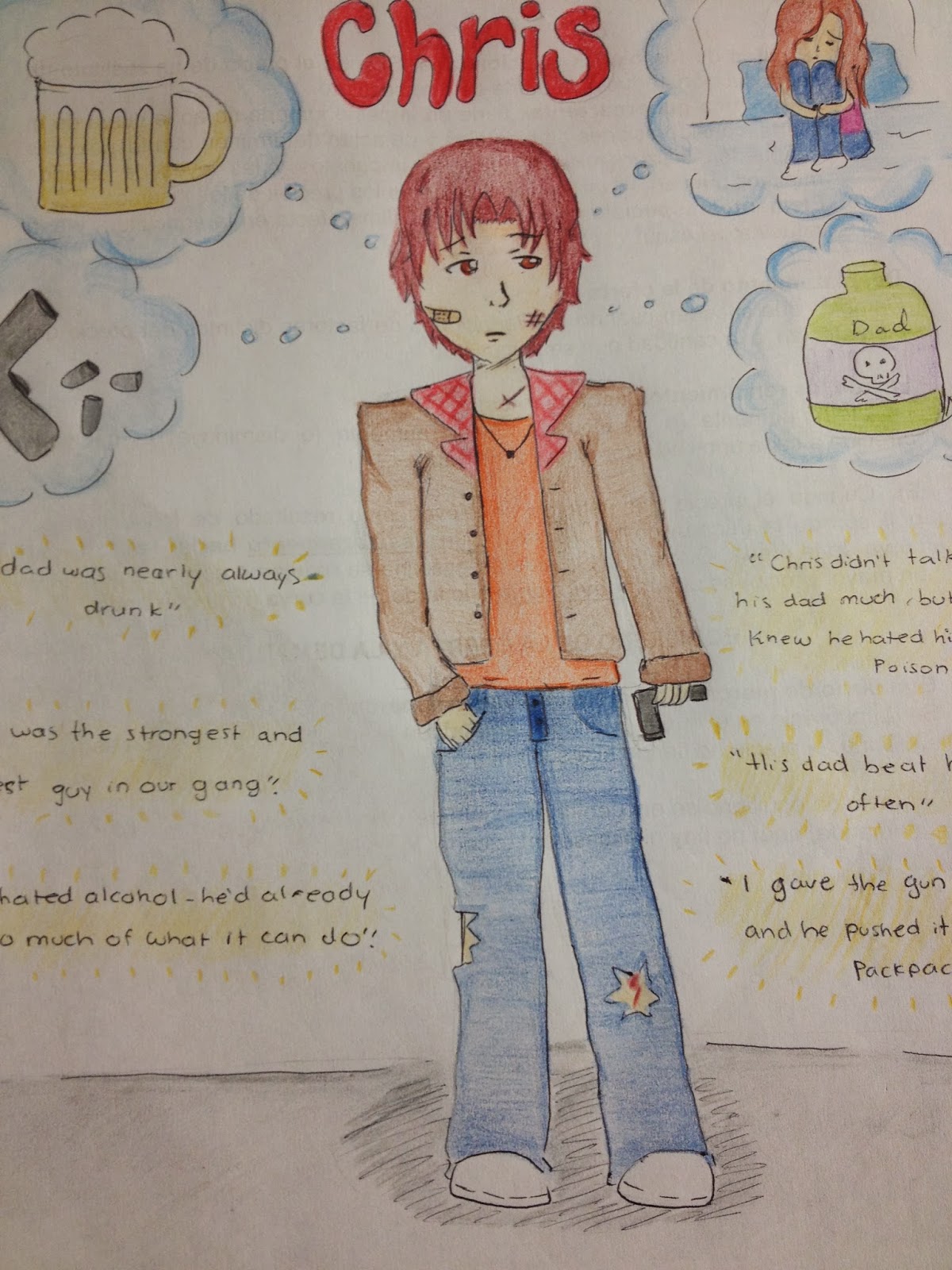
One assignment that I like to do is have them tell me what actor or actress they would like to play a character. They have to give me specific reasons like, "I think _______ should be played by ______ because in the story he's really a wimp and in his most recent movie he plays a wimpy guy." or "The author describes her as short and petite, so I think ______ would be a good actress."
It is also a way to get me to know what kind of movies and actors my students like. What I really like to do though is have them find five quotes from the story and use them to draw a picture of the character.

Here are some examples from the past students:

This is Chris, from Stephen King's, "The Body," I like this one because she really listened when I said it didn't need to just be physical traits. In the story we know Chris is abused, so she took a quote that discussed it and added band aids to his face and a bloody knee. A key point of the novella is that Chris stole his father's gun, so she took a quote about it and drew him with the gun.

 This is Mr. McClane from, Phillip K. Dick's, "We Can Remember It for You Wholesale." I like this because it was simply done and shows it isn't about being the best artist (I am not!) it is about finding the quotes and drawing what they tell you.

This was from the first year I taught at ITESM and the students read Rip Van Winkle. This student didn't take quotes so much as descriptive words, but it still shows a good example of "bringing the story to life."

Similar to my last post about popcorn reading, this is nothing new, but it is something fun that students enjoy and keeps them from answering simple questions, "Who is Chris?" "How old are the boys" "What city do they live in?" Rather than having your students memorize, help them understand! 

You can buy this assignment (with two others and an alternative writing prompt for the students hwo hate drawing) at TeachersPayTeachers for LESS THAN $2.00! Complete with rubrics and examples.

Wednesday, February 5, 2014

Popcorn Reading


I like having students read out loud sometimes. It doesn't need to be a whole story. It just can be the questions and sentences in a grammar assignment, or the directions to an assignment.

Why?
I really focus on pronunciation errors since I already know what they are trying to say, and I don’t need to focus on the content as much as when they are speaking.
This is also how I have discovered some of my students were dyslexic. Not when they make small mistakes, but when I notice they commonly are mixing up bigger words like, “coffee” instead of “office.” These bigger mistakes are often corrected when typing, so reading a set text is the only time I hear them.
There are also many students who show respect when the teacher is talking, but they don’t show respect when other students are talking. By having other students read out loud this gives students a chance to practice respect for one another, not just an authority figure.

How?
One way that I read is called, “Popcorn reading.” The first time I use popcorn reading in class I make to to explain it carefully. The explanation usually goes like this:
“Does anyone know what popcorn is?”
“How do you make it?”
“When you make popcorn do the kernels pop randomly or in order?”
“That’s right it’s random. So, when you start reading you read until I say popcorn. Some people will read a little longer than others. After I’ve said popcorn someone else will read until I say popcorn again. Does everyone understand?”
To make sure they understand, you can ask: “When do you stop reading?” “What word will make you stop?” “Does everyone read the same amount?” ”Are people called in a specific order?”
To start, “Great, are there any volunteers, or shall I pick the first reader?”

Why do I like it?

  1. It keeps things random. When students don’t know when they will be called they have to read along with everyone, instead of counting how many people will read until it is there turn and ignoring everything else.
  2. It also makes it easy to differentiate. Yes, I claim that it is random, but I can tell a student I know struggles with reading, “On Wednesday I am going to call on you to read the second paragraph on page 22. Why don’t you practice it at home a few times, so you can be sure you are ready.” This way they are still participating, but they will have the time to practice and not worry so much about making a fool out of themselves.
  3. Students think it is fun! I don’t know if it is because the word popcorn is silly or because they feel like it is a game(you win by paying attention), but they seem to enjoy it.

Variations
  • After you say popcorn, you call out a student’s name. This is helpful because you can select harder passages for students who are best capable of reading them, or you can call on students who are visibly not paying attention.
  • After you say popcorn, ask a question about what was just read. The student who answers the question gets to read next.
  • After you say popcorn, use a random number generator (or class cards, or Popsicle sticks) to really show you are “making popcorn” and choosing randomly.
  • After you say popcorn the student who was reading gets to call the next name. They like this because they get to pick their friends or crushes. I admit I use this the first weeks when I am trying to get used to the new names.
  • You may want to make the rule that people CAN be picked more than once in a reading. This doesn’t really fit with the popcorn theme, but it keeps them on their toes. If it is a class that does NOT exhibit bullying and they are picking the next reader, I often let them pick the same student over and over again, but ONLY when I know the class (and student) well enough. With the right student the class laughs and the person feels like the center of attention. GREAT for students who love the limelight.
That’s it. A super easy way to have your students read in class. How do you like to have your students read aloud?

Tuesday, February 4, 2014

Smart Questions

OK picture this:

You're in the middle of explaining how to write an essay, or a tricky grammar point.

You've already done the warmer, the model, the example, drawn your visual and maybe made some comparisons. You do some examples on the board and most of the students get it.Then you get one student who raises their hand, "I don't get it" they exclaim.

OK, take a deep breath, "What don't you get?"

"All of it" they respond.

Then your brain starts turning... There's no way you don't get all of it. It's so easy. It's step by step. There's a cute little table on a worksheet explaining quite clearly the different options... and you find yourself slowly getting frustrated with the student.

Now, I hope I am not a bad teacher. I hope other teachers feel this way too. Because the thing is, I like when students ask questions! I understand that for many students it takes a lot of courage to ask a question, and if one student is confused, there is probably another confused student. I just prefer that they are asking good questions!

I was reading a math blog (because I believe all teachers can learn from one another, not JUST English teacher from English teachers) and I found this great goodie. Basically the teacher makes these reminders that go on the students' desks. When they have a question they are reminded to ask smart questions. Here's my version via muzy.

I used to spend a lot of time teaching Bloom's taxonomy, so students would know how to ask good questions. Instead of, "What's the answer." they can ask, "Why did you do this step?" It seems simple, but some students really struggle with asking the right questions.

If you prefer acronyms remind your students their questions should be S.M.A.R.T.

Specific Meaningful Advanced Relevant and Tangible

Here's the great part. Once they start asking the right questions, not only is it easier for us to help them, it is usually easier for them to help themselves! One of my main goals is to make learners more autonomous, so this is a step in the right direction!

How do you make sure your students ask good questions?

Monday, February 3, 2014

How Can I Use Stories or Books with My Adult English Students?

I LOVE to teach English via stories, but some teachers seem more hesitant. This guest blog by Mallory May of Really Learn English focuses on reading in the classroom.

Reading is one of the best ways for students to expand their vocabulary, and it can also be a good opportunity to work on their pronunciation out loud. They also come into contact with idioms and other fixed expressions, as well as seeing in context the grammar structures they’ve studied. 

It’s common for adult learners to groan when we bring reading activities to class. In my experience, this is mostly because
they haven’t had a very entertaining experience with reading activities in the past. They’ve found the topics boring, and the exercises have not made them really use the information they’ve understood by reading.

Adult learners can be tricky, so here are some suggestions that I’ve found very helpful.

Find their interests!
1. Choose something they’ll find interesting
This is the golden rule of working with reading materials! If you have someone who is a news buff, bring in a short current events article. If you have a fiction nut, choose a short story within some genre that they’ve said is interesting to them. And for very avid readers, especially if you’re working one-on-one, novels can even be a great option.


No matter what you pick, you’ll find new vocabulary, phrasal verbs, idioms, and useful grammar structures. The main thing is for your students to actually read it!


2. Find something level-appropriate
You don't want your students to feel the text's too much!
You’re not going to bring in an opinion piece from The Economist for a pre-intermediate group, clearly! When you’re working with adults, it’s important not to choose childish subject matter, but you do need to keep their level and reading abilities in mind. If the text is too difficult for your students, they will quickly become frustrated and bored.


As a general rule, you should choose a text with four or five brand-new vocabulary words in it. If you work with a story or article prepared for language learners, it should include synonyms and descriptions that will help your students to understand.


3. Select short texts that you can cover in one class
Fables and other short stories work well!

I personally love longer short stories, but this is simply not practical if you are working with a group of students. 

Imagine: you begin the story on Monday with your three students. On Wednesday, one is absent, but you continue with the other two. On Friday, the student who was absent is lost, and the others feel bored explaining what has happened in the story.


Of course this is no disaster, but the best reading activities can be completed in one class

You should allot the proper amount of time to read together, check understanding, discuss, and complete the corresponding activities.


4. Be sure the activities are interesting and useful
Have students discuss a character's motivations!
Adult learners don’t miss a beat! If they feel that the activities that go with a reading exercise do not help them to better understand the content or remember the vocabulary, they will feel they are wasting their time.


As you move into intermediate and upper-intermediate levels, open-ended opinion questions for discussion are a great idea. Why did this character do what she did? Why did the government take action against the protesters according to this article? Do you agree?


You can also create debates or role-plays based on the text’s content. Have the students take different sides on an issue or act as the characters in a story. This way, you get speaking practice using the story! Write the vocabulary on the board and challenge the students to make their own sentences with them. Whose sentence is more interesting and uses the most correct grammar? Competition can be a great motivator.

5. Pre-teach vocabulary and have your students read out loud
Have each student read a different character out loud!
It’s important to be very familiar with the text before you go in to class. That way, you know what’s coming! 

Use the board and examples to pre-teach the difficult vocabulary so that students understand the text better. You should also have them read out loud so that they can practice their pronunciation. Dialogues are excellent for this! It’s almost like a role-play within the reading itself.


These tips are general, so now let’s look specifically at ideas on how to use specific types of texts.


Short stories
Smiling while reading is good!
When you’re working with short stories, it’s a great idea for them to be funny or include some kind of punch line at the end. If they make your students smile or laugh, they’ll enjoy the activity much more, and they’ll be more likely to feel enthusiastic about doing more reading! Shoot for topics that are somehow related to your students’ lives – something about living in a city, working in an office, dealing with work relationships, etc. You can even try writing your own stories (about 250 words is a good guide) to practice vocabulary and grammar. Don’t forget to include those jokes!

As we mentioned above, short stories ought to be of a manageable length for a single class period. It’s a great idea to assign some kind of homework (especially writing) according to the level and content of the story. Perhaps your students can write an alternate funny ending or make their own sentences using two or three of the vocabulary words they find the most difficult.

News and other articles
Again, it’s very important to choose your content carefully. On the one hand, it’s great to pick topics that your students can share their opinions about. But on the other hand, we have to be careful of students’ comfort levels (and our own!) as well as cultural sensitivities. In many cultures, it is not polite to talk about religion, politics, or income.

For example, unless you have students who are very comfortable with each other and you, as well as being open and respectful, you shouldn’t consider very controversial topics. Try topics like the environment or life in different world cities.

Books
You won’t often be able to work with novels, but it can be a blast! Advanced students can enjoy the challenge of reading a whole novel in English. If your avid readers are lower-level, check out some simplified and abridged readers appropriate for their level. You can find classic literature, detective novels, romantic stories, or adventures in simplified readers!

Some readers are already equipped with good exercises, but you can go the extra mile for your students by preparing activities for each chapter. Create a list of vocabulary words that your student can keep close at hand when he or she is reading the chapter for homework. Have the student read you his or her favorite passages or confusing sections to you in the following class.

Then create activities - the only limit is your own imagination!

Mallory May is an English teacher and lesson planner for Really Learn English. She has six years’ experience working with adults at all levels in Buenos Aires, Argentina. She is also a literary translator and loves finding new and creative ways to keep her classes interesting and engaging, especially using fiction in the classroom.

If you’re looking for more teaching ideas, visit the teaching center at Really Learn English.
Related Posts Plugin for WordPress, Blogger...